good morning, codyhosterman I used the PureStorage.Pure1
good morning, codyhosterman I used the PureStorage.Pure1 module to get load metrics from Pure1, which worked fine yesterday. But when I run the same script with same cert, etc, I get the message JWT expired. How can I make this authentication process work so if I run it once every hour, I can get authenticated properly? ```$mypwd = "xxxx" $CertObj = Get-PfxCertificate -FilePath C:\Stash\PowerShell-Projects\Pure1\mypfx.pfx -Password $mypwd $pure1_appid = "pure1OSWa2R7FOwejvETD" $PureOneConn = New-PureOneRestConnection -certificate $CertObj -pureAppID $pure1_appid``` reply: `Exception: The Pure1 Organization with ID 1001 is already connected.` ```$PureOneArrays = Get-PureOneArray -arrayProduct FlashArray Invoke-RestMethod: {"message":"JWT is expired"}```2KViews0likes11Comments
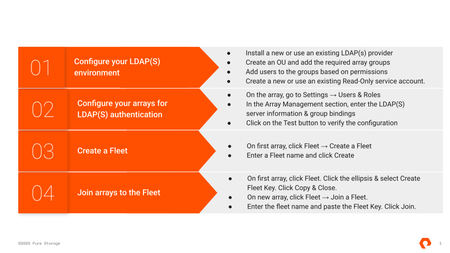
4 steps to enable Pure Fusion
Several teams like yours have recently switched on Pure Fusion and saved 39.5 hours of staff time per day by boosting application-response times. It’s been a game changer for enterprise data management. Read more on how Mississippi Department of Revenue deployed Pure Storage® platform for a faster, more versatile storage to boost application performance, protect data, and support hypervisor mobility. Pure Fusion unifies enterprise data and automates workflows with simplified storage management, workload automation and AI-driven workload placement. With the power of an Intelligent Control Plane, Fusion automates storage management across cloud, edge or core or any protocol file, object or block. Anchoring the Enterprise Data Cloud, it unifies data services and integrates with existing infrastructures, turning complex, manual tasks into streamlined, policy-driven operations. Fusion enables end-to-end automation—freeing you to accelerate innovation while reducing operational risk and overhead. Here are the 4 steps to enable Pure Fusion: Click here for the complete Pure Fusion Quick Start Guide. Using Secure LDAP (LDAPS) requires additional configuration with certificates. Please reference the Quick Start guide for more information. For compatibility reference, please see the Compatibility Matrix.700Views1like1CommentFusion MCP Server Is Now Released & Open Source
There’s a narrow band between “AI demo” and “actually useful in production,” and most tools miss it by a country mile. Fusion MCP Server doesn’t. Now that it’s open source, MCP-compatible AI assistants get a controlled bridge into Everpure FlashArray and FlashBlade environments, one built to answer real operational questions about fleet inventory, capacity, performance, alerts, volumes, file systems, workloads, and presets, without turning your storage estate into a science fair project. The AI Agent doesn’t get to vibe its way through your infrastructure. It works through a clean tool surface backed by real Everpure APIs, and writes stay hidden until you flip them on yourself. What it actually solves If you’ve ever wanted to ask a storage question in plain English and get something better than a dashboard scavenger hunt, this is that. Fusion MCP Server sits between your AI agent and your arrays: the assistant talks to the server, the server authenticates with configured array API tokens, calls supported Everpure APIs, and returns structured results. Your assistant never touches the arrays directly. Practically, that means engineers can ask things like: Show me the fleet overview Which arrays have capacity concerns Show array performance for the last 24 hours List workload presets available in this fleet Show active alerts with remediation links The data was never the problem. Storage teams already have it. What eats the day is bouncing between menus, tabs, and API docs just to answer something like “which arrays are closest to full?” Think of it like swapping a pile of ad hoc curl commands and tribal knowledge for a typed interface your AI assistant can reason over. Calling it “screen scraping with confidence” undersells it. It behaves more like a junior SRE who actually reads the schema. Why engineers should care The release leads with reads, which is exactly the right default for infrastructure tooling. Out of the box, Fusion MCP Server covers fleet overview, capacity and performance, storage objects, configuration audit, and optional supervised actions for placement recommendations, preset creation and updates, and workload deployment. A few details stand out: It works with FlashArray and FlashBlade environments in a Fusion fleet, including mixed environments, as long as you provide at least one token for each platform type for Remote Execution. If the API version you have on your arrays does not yet have the endpoints with Remote Execution capability enabled, you must supply an API token for every array in the fleet. More on that in the next section. Fleet discovery covers the supported read workflows broadly, though some, especially performance, still need a direct token for each array you want to query. Built-in prompts handle fleet, performance, and config workflows, and it also works through plain natural-language questions if your agent doesn’t expose MCP prompts directly. Read-only endpoint documentation plus a whitelisted authenticated GET fetch tool cover supported API surface beyond the dedicated tools. Let’s talk Tokens first Back in Purity REST API version 2.38, Everpure started to include a capability for API endpoints called Remote Execution. This is the mechanism that lets a client invoke a Purity REST API request on a different fleet member, and that request executes as though it were initiated locally on that remote member. The catch is that both arrays must have the same API version available on them as well as the endpoint being executed against must have Remote Execution capability. As of today, not all endpoints have this capability, so there must be an API token specified for each array in the fleet until they have all been enabled. We are diligently working to get all endpoints enabled to make this easier for everyone. Stay tuned! Installation (that does not require a PhD) The setup flow is refreshingly direct: Download the latest binary from GitHub Releases or build from source. Generate API tokens for the arrays you want to query. Run generate-config with your FlashArray and/or FlashBlade targets. Drop the generated config into your MCP-capable agent using the standard start --auth-config pattern over STDIO. generate-config does more than write boilerplate. It validates tokens, detects each array’s API version, resolves array names, and writes the auth config with restrictive permissions: the config directory gets 0700 and the file gets 0600. Want an even easier way? How you just tell your AI Agent to “Read this repository at https://github.com/PureStorage-OpenConnect/fusion-mcp-server and the included USER_GUIDE.md file and add the Fusion MCP server to this agent.” Easy-peasy as it’ll step you thought the process and create the config file for you. A few caveats are worth flagging before you point this at anything that matters: The published binaries aren’t signed, so macOS and Windows may throw a warning on first run. Build from source if that’s a dealbreaker. It’s all there, have at it! Keep the generated auth-config.json local, don’t share it, and rotate tokens if one ever leaks. None of that is friction. It’s the fine print you’d want before trusting a tool with API tokens. Supervised write actions: powerful, optional, and very much not on by default Now for the part everyone asks about first, and the part some people should absolutely not enable first: write actions. Fusion MCP Server hides write tools by default. You turn them on explicitly, either during config generation with --enable-write-tools or later with update-config --enable-write-tools. Enabled, the supervised actions cover these processes with more to come as the product evolves: Placement recommendations Workload preset creation Workload preset updates Workload deployment The approval step is the clever bit. Write operations sit behind an explicit confirmation. If the agent supports MCP Elicitation, the server pops up an interactive dialog for every write tool, so you can review the proposed action and approve or decline before anything changes. If the agent doesn’t support Elicitation, it falls back to telling the agent, in plain instructions, to ask you for approval before resubmitting the call. One practical wrinkle: the write tools inherit whatever permissions live on the API tokens you configure, so the workflow only works if those tokens can perform the write. So when should you flip the switch? Enable write tools if you want supervised acceleration on repeatable workflows: placing a workload from a known preset, updating a policy-backed preset, or turning a natural-language request into a deployment action that still needs a human to sign off. Skip it if you’re still validating token scope, using the server mainly for observability, or introducing MCP to a team that hasn’t built trust in the read-only workflows yet. Start with read-only. Make it boring. Then decide whether supervised writes are the next move. Write tools toggle on and off with a simple update-config command, so this isn’t a one-way door: turn them off again anytime with update-config --enable-write-tools=false. Use cases that actually matter This release isn’t for people who like screenshots of AI chats. It’s for engineers and operators who want faster answers and safer workflows. A few obvious wins: Fleet triage Ask for a fleet overview with alerts, array inventory, Purity version, and fleet connections, the kind of first-response context you want before guessing which dashboard to open. Capacity and performance review Ask which configured arrays have the highest used capacity, which have high latency, or pull performance for the last 24 hours. For teams juggling multiple arrays, this turns routine health checks into a single conversation. Storage object lookup Query volumes by naming pattern, list file systems on FlashBlade, or inspect workloads on a specific array. Useful for anyone who inherited naming conventions from a previous geological era. Configuration audit Use the built-in documentation and read-only fetch coverage to compare settings across arrays and check for policy consistency. Handy if you’re trying to catch drift without hand-rolling an audit script every quarter. Workload lifecycle acceleration Enable supervised writes and the assistant can recommend placement, create or update presets, and deploy workloads from those presets. At that point the server stops acting like a reporting tool and starts acting like an interface layer for intent-driven operations. On My Soapbox: Why the Open Source release matters Being open source here changes the trust model, not just the distribution channel. You can inspect how the bridge works, check the security assumptions yourself, and contribute fixes instead of filing a ticket into the void. When reality disagrees with the documentation, which happens to every project sooner or later, you can open an issue instead of just living with it. The repository is public under Apache 2.0, with contribution guidance, architecture notes, a developer guide, and a dedicated issue tracker for support, issues, and feature requests. That means the people who’ll stress-test this in real environments can also be the ones fixing it. For a tool sitting between AI agents and production-adjacent storage workflows, that’s where the engineering conversation belongs. Final thought Fusion MCP Server is short on hype and long on mechanical sympathy. Read workflows stay front and center, write workflows require your explicit sign-off, and installation doesn’t eat your afternoon. If you’re running Fusion-managed fleets (which y’all should be!), it’s worth a look. Grab the latest release, point it at your MCP-capable agent, start read-only, and see how fast “show me my fleet overview” becomes second nature. It’s open source. Once you’ve kicked the tires, contribute code if you build something useful, and open an issue when you hit an edge case. That’s the whole deal.300Views6likes0Comments
Ask Us Everything Recap: How Pure1 Makes Storage Feel… Easy
If you joined the latest Ask Us Everything session on Pure1, one theme came through clearly: storage management does not have to be complicated. This session, driven by questions from the Everpure Community, explored how Pure1 has grown from a monitoring tool into a self-service control plane with planning, assessments, workflow automation, and proactive support intelligence. Here are some of the highlights. “What is Pure1 actually doing for me?” Pure1 has always been rooted in the rich telemetry that Everpure collects from arrays. Today, it gives customers a single, global view of their environment, making it easier to understand fleet health, performance, support status, and risk. The key point from the experts was that Pure1 is not just showing data. It also helps you decide what to do next. Instead of logging into individual systems or stitching together reports, teams can use Pure1 as a central place to see what is healthy, what needs attention, and where action may be needed. And with AI Copilot, this and much more can even be done via natural language. “Can Pure1 really help with planning?” In traditional storage environments, planning often means spreadsheets, manual analysis, or bringing in outside help. Pure1 changes that by building planning tools directly into the management experience. Admins can model capacity growth, performance trends, hardware upgrades, and the impact of adding new workloads, all within the same plan. Even better, those models are interactive. You can test scenarios, compare options, and see likely outcomes before making changes. That is a major difference from legacy storage, where planning often feels like a separate project. With Pure1, planning becomes part of everyday operations. “What about security and data protection?” Attendees also asked about risk, resiliency, and readiness. Pure1 includes assessments that help teams understand where they stand. Security assessments look at areas such as password hygiene, vulnerabilities, and exposure. Data protection assessments focus on recovery readiness, replication, and SafeMode coverage. That distinction matters. Security is about reducing the chance of something bad happening. Data protection is about being ready when something does. Pure1 helps teams look at both sides, track improvement over time, and identify gaps before they become urgent problems. “How proactive is support, really?” This was one of the strongest examples of how Pure1 differs from traditional storage tools. Pure1 is tied directly into Everpure’s proactive support model. Instead of waiting for customers to find and report issues, Everpure can detect many problems early through telemetry and pattern recognition. That includes early signs of hardware issues, unusual performance behavior, or network conditions that may become problems later. The big takeaway: Pure1 helps spot trouble before it affects performance or availability. The majority of support cases are opened automatically, and customers can track case status and related alerts directly in Pure1. For storage teams, that means fewer surprises and less time spent proving that a problem exists. “Can I customize this for my environment?” Yes, and this is where Pure1 starts to feel less like a dashboard and more like an operations platform. The session touched on workflow orchestration and alerting, including the ability to create custom alerts, route notifications to tools like email or Slack, and build simple response workflows. And AI Copilot further simplifies the customization process. That flexibility is important because every environment is different. Pure1 provides built-in intelligence, but also gives teams ways to adapt it to their own operational processes. “What about file and object data?” Attendees asked whether those capabilities would be visible in their current Pure1 experience. The answer was yes. Pure1 provides visibility across protocols, including block, file, and object, without requiring separate tools. That consistency reflects Everpure’s broader design goal: add capability without adding complexity. Final thoughts The biggest takeaway from the session was simple: Pure1 turns storage management into a self-service experience. Instead of: Reacting to problems Relying on external analysis Managing systems one by one You’re able to: Plan proactively Assess continuously Automate intelligently, across your data estate For technical practitioners, that means less time in spreadsheets, fewer manual checks, and more confidence managing storage at scale. And based on the questions from the community, that is exactly the kind of simplicity storage teams are looking for. Find out more about how Pure1 enables the Everpure Intelligent Control Plane here. Check out this and all our other Ask Us Everything sessions. And, keep the conversation going by jumping into the Everpure Community.200Views2likes0CommentsWhat’s the most frustrating part of managing large-scale storage for you?
Managing storage at scale can be a lot at times! What’s the most frustrating part of managing large-scale storage for you? Is it the constant troubleshooting, juggling different systems, or just the pressure of making sure nothing goes down? Check out these demos on how to simplify operations, automate the tedious stuff, and stay ahead of issues before they happen.109Views0likes0Comments
Dear All, I need to understand what's the value I have
Dear All, I need to understand what's the value I have to consider... what's this value in percent ? 50% ? 60% ? I don't understand which value/scale I have to consider Thanks a lot PS C:\Users\kapomony> Get-PureOneArrayBusyMeter -objectName PURE-XXX -startTime (get-date).AddDays(-1) -EndTime(get-date) id : 8c25e15a-8142-37dd-8e88-174e6071e962 name : array_total_load aggregation : avg data : {1642951260000 0.23213207415899517, 1642951440000 0.21638453490340798, 1642951620000 0.1954585235051682, 1642951800000 0.2731861336504102...} resolution : 180000 resources : {@{id=15d4c39b-d74d-4b22-8310-731c0ddcc7c1; name=PURE-XXX; resource_type=arrays; unit : _as_of : 1643033160000103Views0likes0Comments