Your Last Line of Defense: Everpure + CrowdStrike: Active Defender in Action
October 20 | Register Now AI attacks breach in 29 minutes, driving ransomware toward $74B, while 90% of logs sit invisible in cold tiers*. See how Everpure and CrowdStrike Falcon® bring together visibility, intelligence, investigation, and automated response to turn storage into an active defender. Key takeaways: Extensive CrowdStrike and Everpure integrations: How Falcon NG-SIEM (visibility), Threat Graph (intelligence), Falcon LogScale (investigation), and Fusion SOAR (response) cover the full detect-to-remediate lifecycle. Closed-loop architecture: How telemetry, normalization, triage, and SOAR action combine so storage events become one continuous detection-to-response loop. Speed to containment: How Fusion SOAR turns a FlashArray™ or FlashBlade® detection into containment action within seconds, not hours. *(Source: 2026 CrowdStrike Global Threat Report) Register Now!58Views0likes0CommentsBeyond Awareness: Awareness Won't Save You, Recovery Will
October 15 | Register Now AI has compressed breakout times to minutes, exposing the gap between knowing you're at risk and recovering from it. Rick Orloff, CISO, and Chris Brandt, Consulting Field Solutions Architect, show why resilience, not awareness, decides survival, and how to build the active-defender architecture that closes the gap. We’ll cover: Worse than expected — how the AI threat has grown dramatically in 2026. Backup vs. cyber recovery, and why you need a tested "minimum viable business" plan. How storage becomes an active defender: built-in security, connected detection, dynamic recovery. A real Fortune 100 recovery story showing resilience in action when prevention fails. Register Now!52Views0likes0CommentsOracle Resiliency: Choosing the Right Data Protection Approach for Every Failure
October 1 | Register Now Oracle recovery requires more than a backup strategy. Accidental deletion, logical corruption, infrastructure failure, site loss, and ransomware demand different combinations of backup, snapshots, and replication. This session explains where each data protection layer does and doesn’t belong in an Oracle recovery architecture. Through practical failure scenarios, we’ll examine how to align RPO, RTO, retention, availability, and recovery-location requirements with the right recovery mechanism. You’ll also learn how to identify overlap, avoid common recovery gaps, and use storage automation to apply consistent protection policies across production, development, test, and DR environments. Session takeaways: Map Oracle failure scenarios to the appropriate data recovery mechanism. Identify protection overlap, operational complexity, and recovery gaps before an incident exposes them. Translate workload requirements into practical RPO, RTO, retention, availability, and recovery-location decisions. Register Now!55Views0likes0CommentsFrom CSI to Snapshots: Seamless VM Management on Red Hat OpenShift
September 22 | Register Now Red Hat OpenShift Virtualization is an increasingly popular option for organizations migrating workloads to a new hypervisor. Rather than being an afterthought, storage is actually a critical element of any OpenShift Virtualization deployment. Join this webinar for a set of short demos of Everpure FlashArray™ with Red Hat OpenShift. We'll go from the ground up: connecting the Container Storage Interface (CSI) to storage, spinning up a virtual machine (VM) from a template, and protecting the VM with instant, array-based snapshots. These demos will show how naturally FlashArray fits into an OpenShift environment. Get connected: See how to set up the CSI with the Portworx® operator and define both the StorageCluster and the StorageClass. Run and protect: We’ll demonstrate both VM provisioning in OpenShift Virtualization plus how to create instant, space-efficient snapshots. Register Now!385Views0likes0Comments
Cooking with “Enterprise Data Cloud”: Recipes for your Datacenter
September 24 | Register Now! Looking for practical ways to streamline your datacenter or hybrid cloud environment and run it more reliably? Following up from last September’s episode, “Cloud - A Place or a Strategy? Unpacking the Everpure Enterprise Data Cloud” (EDC) with JD Wallace, host Andrew Miller invites Michael Sasse (Principal Technology Strategist with Everpure for 11 years) to discuss how to make EDC real for YOU in the midst of the many industry changes from even just 12 months ago. We’ll explore: Changing customer needs: What Michael has heard as he discusses EDC with customers, including how speed and efficiency matters more than ever and the risk of being replaced if you’re perceived as the “department of no”. What EDC is: If you love dogs, you’ll love this (join us to see why). We’ll look at how EDC is driving the simplicity that FlashArray™ brought to the storage industry throughout the datacenter and cloud. Cooking the EDC souffle (making It real): We’ll look at the building blocks of EDC from a technical perspective — things like Fleets, Topology Groups, Presets, observability, governance, automation and more. Of course, underpinning all of this is Evergreen//One™. Presenting to the (exec) table: Think of this as delivering the meal. Having reviewed the building blocks, we’ll look at the outcomes both you and your executives care about. Think of this as 1) who is leveraging EDC, 2) how has it helped (measurable outcomes), and 3) why does it matter? Even better, we’ll discuss the EDC Blueprint: how Everpure is linking our products and features to outcomes that your CIO and CTO care about. September 24 | Register Now!123Views0likes0CommentsFlashArray Meets Nutanix, Independently Scale Compute and Storage
September 24 | Register Now Traditional hyperconverged infrastructure ties compute and storage together, forcing you to add nodes you don't need just to gain capacity. This webinar shows infrastructure and storage admins how pairing Everpure FlashArray with the Nutanix Cloud Platform over NVMe/TCP breaks that dependency, delivering external, high-performance block storage to Acropolis Hypervisor (AHV) clusters. You'll walk through the reference architecture in detail, including how the two platforms connect and how data services like VM-level snapshots, replication, and SafeMode ransomware protection layer beneath your Nutanix workloads. The result is an architecture you can scale on your terms, expanding compute and storage independently while maintaining the enterprise data services and non-disruptive operations your workloads depend on. Key takeaways: How FlashArray connects to Nutanix AHV over NVMe/TCP, and what the end-to-end reference architecture looks like in practice Why disaggregating compute and storage eliminates node overprovisioning and lowers TCO without sacrificing performance How to extend enterprise data services — snapshots, replication, and ransomware-resistant immutable snapshots — beneath your Nutanix workloads What non-disruptive upgrades and independent scaling mean for day-2 operations and long-term capacity planning Register Now350Views0likes0CommentsActionable Assessments: Prepare Your Infrastructure for Oracle 26ai
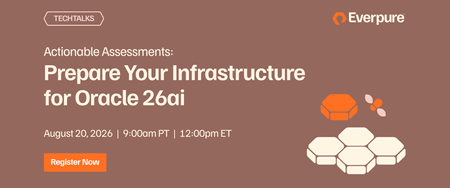
August 20 | Register Now As organizations adopt Oracle AI Database 26ai with capabilities like AI vector search, understanding whether their existing data infrastructure can support these new workloads becomes increasingly important, while keeping costs under control. Join us as we explore how to analyze peak workload concurrency, optimize storage redundancy, and map advanced feature dependencies. Attendees will walk away with an actionable framework for evaluating their own environment, including access to a complimentary, privacy-first Everpure readiness assessment to help automate the planning process. Key takeaways: See your true workload and capture a consolidated, hour-by-hour view of peak demand. Crush storage bloat and learn how real-world environments are safely shrinking their storage footprints. Learn how to align infrastructure for active features like TDE, HCC, and Smart Scan without over-buying hardware. Secure your assessment and get exact sizing recommendations. Register Now!73Views0likes0CommentsEnterprise Data Cloud: Managing Data, Not Just Storage
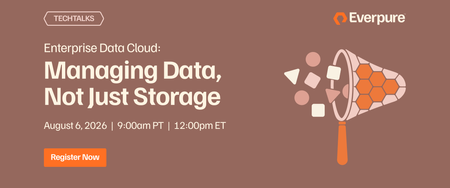
August 6 | Register Now Infrastructure teams have always managed applications. AI requires them to manage data. That's a different challenge, and most platforms weren't built for it. The Enterprise Data Cloud architecture from Everpure bridges that gap, bringing data intelligence into the same platform infrastructure teams already manage, so infrastructure and data teams are finally working from a single, unified view. In this session, we'll dig into what it means to manage a platform built for both operational performance and AI readiness, and the changes when infrastructure can finally gain visibility into its data, not just storage. Key takeaways: Why the shift from application-centric to data-first infrastructure changes how platforms need to be managed How Everpure brings data intelligence into the operational layer without adding tools, teams, or complexity What shared visibility across infrastructure and data teams actually unlocks for AI initiatives How to manage a platform that serves every workload, from archive to AI Register Now!209Views0likes0CommentsEnterprise Storage for Kubernetes: Extending FlashArray Excellence with Portworx Enterprise
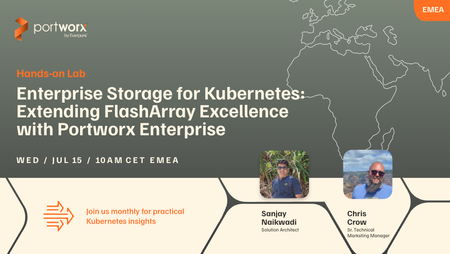
Register Now - July 15! Your FlashArray is already delivering the performance, reliability, and data services your organization depends on. Now Kubernetes is coming to your environment and your applications are following. The question isn’t whether to support stateful Kubernetes workloads. It’s how to do it without sacrificing the storage control, visibility, and SLAs you’ve spent years building. In this live Hands-on Lab, we’ll show storage administrators how Portworx Enterprise (PXE) extends your FlashArray investment directly into Kubernetes. You’ll walk away knowing how to: Provision and manage persistent storage for stateful Kubernetes workloads backed by FlashArray performance Leverage Cloud Drives and StorageV2 to build flexible, scalable storage pools that fit your existing architecture Enforce storage policies and QoS across application teams with Application IO Control and multi-tenancy guardrails Automate capacity management with Portworx Autopilot — so volumes grow on demand without manual intervention or after-hours firefighting Whether you’re being asked to support your first Kubernetes namespace or managing a fleet of clusters, this session gives you a practical, storage-admin-first view of how to extend your FlashArray expertise into the Kubernetes era. Register Now - July 15!93Views0likes0CommentsEnterprise Storage for Kubernetes: Extending FlashArray Excellence with Portworx Enterprise
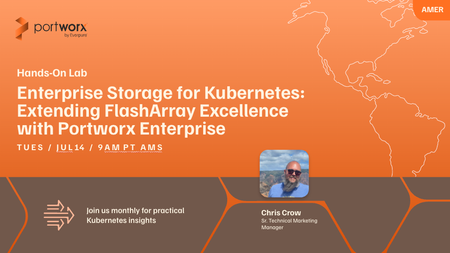
Register Now - July 14th! Your FlashArray is already delivering the performance, reliability, and data services your organization depends on. Now Kubernetes is coming to your environment and your applications are following. The question isn’t whether to support stateful Kubernetes workloads. It’s how to do it without sacrificing the storage control, visibility, and SLAs you’ve spent years building. In this live Hands-on Lab, we’ll show storage administrators how Portworx Enterprise (PXE) extends your FlashArray investment directly into Kubernetes. You’ll walk away knowing how to: Provision and manage persistent storage for stateful Kubernetes workloads backed by FlashArray performance Leverage Cloud Drives and StorageV2 to build flexible, scalable storage pools that fit your existing architecture Enforce storage policies and QoS across application teams with Application IO Control and multi-tenancy guardrails Automate capacity management with Portworx Autopilot — so volumes grow on demand without manual intervention or after-hours firefighting Whether you’re being asked to support your first Kubernetes namespace or managing a fleet of clusters, this session gives you a practical, storage-admin-first view of how to extend your FlashArray expertise into the Kubernetes era. Register Now!86Views0likes0Comments