A Petaflop in Your Backpack: RTX Spark and the Shift to Local AI
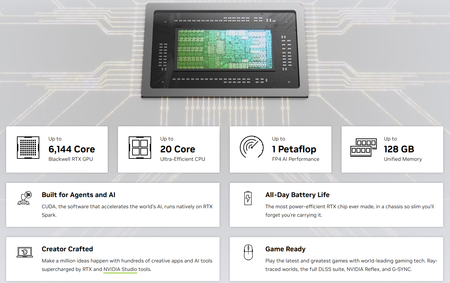
Alt headlines to A/B test: The Cloud-Bill Killer? RTX Spark Puts a Full Petaflop of AI on Your Lap Local AI Just Got Serious: 128 GB and a Petaflop, Unplugged Stop Renting GPUs. RTX Spark Brings Data-Center AI to Your Desk — and Your Bag For the last few years, doing real AI work meant one thing: renting someone else's hardware. Spin up an instance, watch the meter run, ship your data to a server you don't control, and hope the latency cooperates. RTX Spark is a bet that the next era looks different — that the most interesting AI will run where you are, on hardware you own. And the spec sheet backs up the ambition. The numbers that matter to builders Up to 1 petaflop of FP4 AI performance Up to 128 GB of unified memory Up to 6,144 cores of Blackwell RTX GPU Up to 20 cores of ultra-efficient CPU If you build with AI, two of these should stop your scroll. A full petaflop of FP4 is the kind of throughput that turns "let it run overnight" into "let it run over lunch." And 128 GB of unified memory is the unlock almost no portable machine offers: CPU and GPU share one giant pool, so you can hold large models and big context entirely in memory — no swapping, no artificial caps on the size of what you load. The workloads that used to demand a rack now fit in a bag. Why this is a big deal for AI work CUDA runs natively. The platform that accelerates the world's AI runs at full speed on RTX Spark — meaning the frameworks, libraries, and agentic stacks you already use just work. No exotic ports, no "supported soon." That changes the day-to-day in three concrete ways: Fewer cloud bills. Prototype, fine-tune, and run inference locally instead of burning credits every time you iterate. Your data stays yours. Sensitive datasets never leave the device — a quiet superpower for anyone working under compliance or NDA. Build agents anywhere. A genuinely portable petaflop means you can develop and test agentic workflows on a train, in a client's office, or off the grid entirely. For the wave of teams building agents and AI products right now, "local-first" stops being a compromise and starts being an advantage. A petaflop that doesn't need a power brick Here's the part that makes the rest believable: RTX Spark is built around the most power-efficient RTX chip ever made. That efficiency is why a petaflop can live in a slim chassis and last all day. Performance you can only use while tethered to a wall isn't really portable performance — and that's the trap RTX Spark is designed to avoid. When the work is done It's not all inference and fine-tuning. The same silicon makes RTX Spark a creator's machine — hundreds of creative apps and AI tools accelerated by RTX and NVIDIA Studio — and a genuine gaming rig after hours, with ray tracing, the full DLSS suite, NVIDIA Reflex, and G-SYNC. One device, three lives. The takeaway The story of AI has been a story of renting access to power. RTX Spark points at a different future: owning it, carrying it, and pointing it at whatever you're building — without the meter running. So here's the real question If you had a portable petaflop with 128 GB of unified memory, what's the first thing you'd run on it — a local LLM, an agent swarm, your own fine-tune? Drop it in the comments. I'm genuinely curious what this community would build first.180Views1like0CommentsIntroducing Pure Storage Data Stream for AI Data Readiness
Cool news to share from Pure's presence at NVIDIA GTC this week - the announcement of a new solution - Pure Storage Data Stream - that accelerates data readiness by automating and speeding up the ingestion, transformation, and optimization of data for enterprise AI pipelines. "Data Stream is a GPU-centric AI-powered, integrated hardware and software stack built for data readiness to automate and accelerate the ingestion, transformation, and optimization of data for enterprise AI pipelines. It is a core component of Pure Storage Data Platform built for enterprise inference use cases, using the NVIDIA AI Data Platform reference design, a comprehensive, single-appliance, jointly engineered infrastructure stack tailored for AI inference via generative AI applications." Register for a preview here: https://www.pure.ai/data-stream.html Blog announcement: https://blog.purestorage.com/products/driving-the-future-of-ai-data-readiness-pure-storage-data-stream/768Views0likes0CommentsAccelerate Breakout Replay: Feeding the Beast: Designing Storage Architectures to Optimize GPU Utilization
Explore how to build AI-ready storage with high-throughput, low-latency architectures to keep GPUs fed while eliminating I/O bottlenecks. Speakers: Kevin Parker Ed Hsu Mike Webb, Silicon Labs https://www.purestorage.com/video/webinars/designing-storage-architectures-to-optimize-gpu-utilization/6375343080112.html95Views1like0CommentsAccelerate Breakout Replay: Panel Discussion - How to Make AI Succeed in Your Organization
Hear from experts on how to build scalable AI platforms with Pure Storage & Portworx®—balancing data, infrastructure, and performance. Speakers: Nathan Wood Victor Olmedo Tony Paikaday, NVIDIA https://www.purestorage.com/video/webinars/how-to-make-ai-succeed-panel/6375339058112.html115Views0likes0CommentsIn what ways do you think AI advancements like BioNeMo
In what ways do you think AI advancements like BioNeMo could impact the speed of drug discovery? Pure Storage has partnered with NVIDIA to create an innovative AI-driven solution aimed at revolutionizing drug discovery. Leveraging NVIDIA BioNeMo and Pure Storage's robust infrastructure, this solution addresses the increasing data demands in pharmaceutical research. Check it out!132Views0likes0Comments