Ask Us Everything Recap: How Pure1 Makes Storage Feel… Easy
If you joined the latest Ask Us Everything session on Pure1, one theme came through clearly: storage management does not have to be complicated. This session, driven by questions from the Everpure Community, explored how Pure1 has grown from a monitoring tool into a self-service control plane with planning, assessments, workflow automation, and proactive support intelligence. Here are some of the highlights. “What is Pure1 actually doing for me?” Pure1 has always been rooted in the rich telemetry that Everpure collects from arrays. Today, it gives customers a single, global view of their environment, making it easier to understand fleet health, performance, support status, and risk. The key point from the experts was that Pure1 is not just showing data. It also helps you decide what to do next. Instead of logging into individual systems or stitching together reports, teams can use Pure1 as a central place to see what is healthy, what needs attention, and where action may be needed. And with AI Copilot, this and much more can even be done via natural language. “Can Pure1 really help with planning?” In traditional storage environments, planning often means spreadsheets, manual analysis, or bringing in outside help. Pure1 changes that by building planning tools directly into the management experience. Admins can model capacity growth, performance trends, hardware upgrades, and the impact of adding new workloads, all within the same plan. Even better, those models are interactive. You can test scenarios, compare options, and see likely outcomes before making changes. That is a major difference from legacy storage, where planning often feels like a separate project. With Pure1, planning becomes part of everyday operations. “What about security and data protection?” Attendees also asked about risk, resiliency, and readiness. Pure1 includes assessments that help teams understand where they stand. Security assessments look at areas such as password hygiene, vulnerabilities, and exposure. Data protection assessments focus on recovery readiness, replication, and SafeMode coverage. That distinction matters. Security is about reducing the chance of something bad happening. Data protection is about being ready when something does. Pure1 helps teams look at both sides, track improvement over time, and identify gaps before they become urgent problems. “How proactive is support, really?” This was one of the strongest examples of how Pure1 differs from traditional storage tools. Pure1 is tied directly into Everpure’s proactive support model. Instead of waiting for customers to find and report issues, Everpure can detect many problems early through telemetry and pattern recognition. That includes early signs of hardware issues, unusual performance behavior, or network conditions that may become problems later. The big takeaway: Pure1 helps spot trouble before it affects performance or availability. The majority of support cases are opened automatically, and customers can track case status and related alerts directly in Pure1. For storage teams, that means fewer surprises and less time spent proving that a problem exists. “Can I customize this for my environment?” Yes, and this is where Pure1 starts to feel less like a dashboard and more like an operations platform. The session touched on workflow orchestration and alerting, including the ability to create custom alerts, route notifications to tools like email or Slack, and build simple response workflows. And AI Copilot further simplifies the customization process. That flexibility is important because every environment is different. Pure1 provides built-in intelligence, but also gives teams ways to adapt it to their own operational processes. “What about file and object data?” Attendees asked whether those capabilities would be visible in their current Pure1 experience. The answer was yes. Pure1 provides visibility across protocols, including block, file, and object, without requiring separate tools. That consistency reflects Everpure’s broader design goal: add capability without adding complexity. Final thoughts The biggest takeaway from the session was simple: Pure1 turns storage management into a self-service experience. Instead of: Reacting to problems Relying on external analysis Managing systems one by one You’re able to: Plan proactively Assess continuously Automate intelligently, across your data estate For technical practitioners, that means less time in spreadsheets, fewer manual checks, and more confidence managing storage at scale. And based on the questions from the community, that is exactly the kind of simplicity storage teams are looking for. Find out more about how Pure1 enables the Everpure Intelligent Control Plane here. Check out this and all our other Ask Us Everything sessions. And, keep the conversation going by jumping into the Everpure Community.86Views2likes0CommentsPure1 Feature Request: Assets > Genealogy milestones overlaid on Analytics > Performance graphs
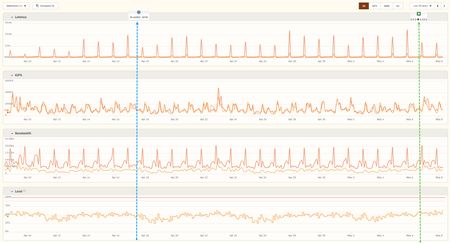
It would be helpful in analyzing and correlating array performance profile changes if genealogy events for an array (either controller replacement via Evergreen NDU or even PurityOE upgrades vis SSU) could be overlaid on the Analytics > Performance graph data for the array and time period selected. I attached a crude mockup of the idea, but I'm sure it could be done much more elegantly and less visually intrusively with a small floating tick mark with a hover effect showing the genealogy change to the array. It could get complicated when graphing performance data for multiple arrays, but could be handled in the same way it is for the performance graphing with a different color per array. Or instead of overlaying the genealogy data as default, perhaps add a "Display Genealogy" checkbox option to the performance graphs. And I'll use this opportunity to once again beat the drums for extending the data retention in Pure1 to >30 days to help identify longer performance trends, which are sometimes not easily visible in a max 30-day performance data windows.228Views2likes1CommentAsk Us Everything about Pure1® Self-service!
💬 Get ready for our first May 2026 edition of Ask Us Everything, this Friday, May 1st at 9 AM Pacific. This month is all about Pure1® Self-service. If you have a burning question, feel free to ask it here early and we'll add it to the list to answer on Friday. Or if we can't get it answered live, our Everpure experts can follow up here. jclark, mbradford plus dpoorman dpoorman are the moderators and experts answering your questions during the conversation as well as here on the community. See you this Friday! (Oh, and if you haven't registered yet, there's still time!)419Views1like0CommentsAsk Us Everything Recap: Rethinking Storage with the Intelligent Control Plane
The latest Ask Us Everything session focused on a topic that’s quickly becoming central to Everpure’s strategy: the intelligent control plane. And based on the questions from the community, it’s clear that many teams are starting to think beyond individual arrays and toward managing storage as a unified platform. Here are the key takeaways—driven by the questions attendees asked and the answers from Everpure experts Don Poorman, Zane Allyn and Mike Nelson. “Do I need to rebuild my automation to use Everpure Fusion?” Most teams already have automation in place, whether it’s Terraform, Ansible, or years of scripts. The good news: you don’t have to start over. Everpure Fusion is API-driven, so existing workflows can stay intact. In practice, you’re simply shifting from targeting individual arrays to targeting the fleet as a whole. That often means adding a parameter, not rewriting everything. Everpure Fusion picks up where any existing automation gets bogged down, so tasks get simpler as you scale, not more complex. The takeaway: Everpure Fusion helps you scale your existing automation—it simplifies, standardizes and extends it across your data estate. “What does API-first really mean here?” At Everpure, API-first isn’t just a label. The APIs are built before the GUI, which means everything you can do in the GUI is already available programmatically. For practitioners, that translates to flexibility. Whether you’re scripting, using infrastructure-as-code, or experimenting with AI-driven workflows, you’re not waiting for features to be exposed—you already have access. It’s a subtle difference from legacy storage, where automation often lags behind the interface. “How do I approach automation without losing control?” Attendees raised a common concern: automation can feel risky. The advice was straightforward—start with outcomes, not everything at once. Automate a single workflow, apply guardrails, and expand gradually. Automation here isn’t about removing control. It’s about: Reducing repetitive work Minimizing human error Freeing up time for higher-value tasks For most admins juggling multiple systems, that shift is practical—not theoretical. “What does this look like in real workflows?” One of the most relatable examples discussed was a ServiceNow-style request flow. Instead of manually provisioning storage across multiple systems, a user submits a request describing what they need—performance, protection, and resiliency. From there, Everpure Fusion and Pure1 handle the process automatically. The result is faster, more consistent delivery with fewer manual steps. More importantly, it abstracts the complexity away from both the admin and the requester. That’s a major difference from legacy environments, where admins must manage each step across each array. “What do I actually need to install?” This answer surprised some people. Everpure Fusion isn’t a separate product. It’s built into Purity. Once you’re on the right version (Purity//FA 6.8.1 or later, Purity//FB 4.5.5 or later), getting started is simple: Create a fleet Add arrays That’s it. No additional infrastructure, no separate control plane to deploy. This lowers the barrier significantly and makes it easy to start small and build as your needs require. “How does this scale?” As expected, scale came up quickly. Instead of managing arrays individually, Everpure Fusion introduces fleet-level management. New capabilities like topology groups allow further organization within that fleet—by region, workload, or compliance requirements. This is where Everpure’s approach really diverges from legacy storage. You’re no longer limited to thinking in terms of hardware. You can organize storage in ways that reflect how your business actually operates. “What happens if something fails?” Everpure Fusion is distributed across the arrays in the fleet. There’s no single point of failure. If one system goes offline, the rest of the fleet continues operating normally. That design keeps management resilient while still enabling centralized control. Final thoughts The biggest shift highlighted in this session is simple: Stop managing arrays. Start managing outcomes. With the intelligent control plane—powered by Everpure Fusion and Pure1—Everpure enables: Policy-driven automation Fleet-scale visibility Simpler, faster operations For storage teams, that means less time on manual tasks and more time focused on how data supports the business. And based on the conversation, that’s exactly where our customers want to go. Find out more about the Everpure Intelligent Control Plane here. Check out this and all our other Ask Us Everything sessions. And, keep the conversation going by jumping into the Everpure Community.319Views1like0CommentsAsk Us Everything About Intelligent Control with Everpure Fusion + Pure1
💬 Get ready for our April 2026 edition of Ask Us Everything, this Friday, April 17th at 9 AM Pacific. This month is all Intelligent Control with Everpure Fusion + Pure1. If you have a burning question, feel free to ask it here early and we'll add it to the list to answer on Friday. Or if we can't get it answered live, our Everpure experts can follow up here. Allynz, mikenelson-pure, plus dpoorman are the moderators and experts answering your questions during the conversation as well as here on the community. See you this Friday! (Oh, and if you haven't registered yet, there's still time!) Or, check out this self-serve resource: Presets and Workloads in Everpure Fusion video Pure Fusion Presets and Workloads: Enabling Automation Innovation for Storage Workloads Unlock the Future of Data Management with Pure Fusion File Presets434Views0likes0Comments
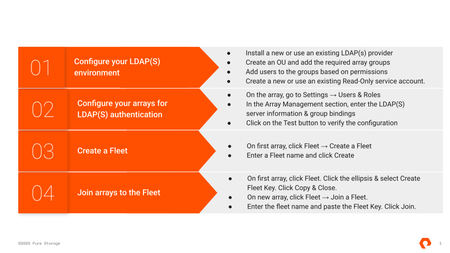
4 steps to enable Pure Fusion
Several teams like yours have recently switched on Pure Fusion and saved 39.5 hours of staff time per day by boosting application-response times. It’s been a game changer for enterprise data management. Read more on how Mississippi Department of Revenue deployed Pure Storage® platform for a faster, more versatile storage to boost application performance, protect data, and support hypervisor mobility. Pure Fusion unifies enterprise data and automates workflows with simplified storage management, workload automation and AI-driven workload placement. With the power of an Intelligent Control Plane, Fusion automates storage management across cloud, edge or core or any protocol file, object or block. Anchoring the Enterprise Data Cloud, it unifies data services and integrates with existing infrastructures, turning complex, manual tasks into streamlined, policy-driven operations. Fusion enables end-to-end automation—freeing you to accelerate innovation while reducing operational risk and overhead. Here are the 4 steps to enable Pure Fusion: Click here for the complete Pure Fusion Quick Start Guide. Using Secure LDAP (LDAPS) requires additional configuration with certificates. Please reference the Quick Start guide for more information. For compatibility reference, please see the Compatibility Matrix.335Views1like1CommentAsk us everything about Purity Upgrades!
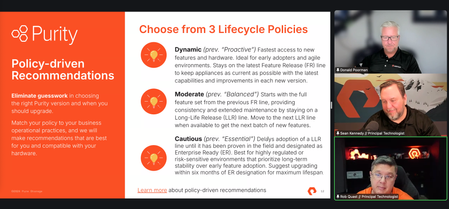
💬 Have more questions for our experts around Purity Upgrades after today's live "Ask Us Everything"? Feel free to drop them below and our experts will answer! dpoorman , skennedy , rquast , jhoughes tag your it! You can also check out these upgrade resources: Bulk self-service upgrades demo video Upgrade your own FlashArray with Pure1 blog Fleet-wide self-service upgrades brief574Views3likes3Comments
Feature Request for Puritan Heroes — Manage snapshot schedules directly in Pure1
An opportunity to shine Summary / problem Today, snapshot scheduling and edits are performed per-array (e.g., via Purity protection policies / groups). At fleet scale this is manual, slow for change control, and hard to audit centrally. We’d like first-class, Pure1-native capabilities to create, modify, and bulk-apply snapshot schedules—without logging into each array. Impact / why this matters Fleet operations: one place to set/adjust RPO/retention across many FlashArrays/FlashBlades. Change management & compliance: audited, role-scoped changes with approver workflow. Risk & capacity: pre-change impact analysis (capacity, performance) using Pure1 telemetry. Consistency: policy templates and guardrails reduce configuration drift. Scope (initial ask) Pure1 UI “Snapshot Policies” workspace to create/edit/delete schedules and retentions (minute/hour/day/week/month), including SafeMode/immutability options where supported. Bulk Apply/Override to multiple arrays, volume groups, file systems/shares. What-if capacity forecast prior to save (based on Pure1 analytics). Change review & approvals (optional), with rationale and ticket ID fields. Maintenance/blackout windows and exceptions. Full audit trail (who, what changed, before/after, when, target objects). RBAC: granular rights (view vs. edit vs. approve), and per-array or per-group scoping. Pure1 Public API New endpoints to programmatically create/read/update/delete snapshot policies, bind/unbind them to objects, run an on-demand snapshot from a policy, and pull audit events—so we can integrate with CI/CD and ITSM. (We rely on Pure1 API today for telemetry; adding write ops for policies would unlock safe automation.) Edge / connectivity Use Pure1 Edge Service for secure, two-way execution on arrays. Include graceful handling for dark/offline assets (queue and notify). Acceptance criteria (examples) From Pure1, I can create a policy “gold-daily-35d” and attach it to 100+ arrays / 1,000+ objects in a single operation. A non-admin can propose a policy change; an approver must OK it before it takes effect. Audit page shows a human-readable diff (before/after crontab-style schedule and retention) plus API payloads. Capacity impact estimator shows expected snapshot object growth over 30/90 days based on historical change rates. API: POST /snapshot-policies, PATCH /snapshot-policies/{id}, POST /snapshot-policy-attachments, GET /audit-events?type=snapshot_policy. Nice-to-haves Prebuilt policy templates (e.g., 15-min RPO for 24h + daily 35d + monthly 12m). Guardrails (“warn/deny if estimated growth > X TB or RPO < Y min”). Service-now/Jira webhook on approval/change. Environment Mixed FA/FB fleet; Pure1 connected, Edge Service available. SafeMode enabled on arrays requiring immutability. Thanks in advance - Garry Ohanian284Views2likes1CommentAccelerate Breakout Replay: Powering the Autonomous Enterprise with Pure1®
Discover how Pure1® uses AI to deliver self-service, automated storage ops with intelligent diagnostics, insights, and performance tools. Speakers: Payal Srivastava Kshitij Pandya Bryan White, Match.com https://www.purestorage.com/video/webinars/powering-autonomous-enterprise-with-pure1/6375770841112.html88Views0likes0CommentsFREE BEER FOR ALL!!! Now That I Have Your Attention, Let's Talk About Purity Updates.
WAIT WAIT WAIT - don't leave yet because of my free beer tomfoolery....hear me out. Listen, we get it. Storage OS updates are historically the LAST thing you ever want to consider for your already impossibly thin maintenance windows. And, we all know NOBODY ever grew up saying, "When I get older, I want to manage enterprise storage for its rock and roll lifestyle." 😀 But - hear me out. Any past pain, suffering, or heavy drinking you may have taken on during previous OS updates with other legacy vendors has been minimized or even flat out eliminated by how we handle updating Purity for FlashArray and FlashBlade. We offer two tracks you can leverage for making them happen by either working directly with support for a white glove update experience where they do all the work remotely, or you can complete them via the Self Support Update (SSU) feature built into Pure1. We encourage regular Purity updates for two reasons: Performance. stability and security improvements...obviously New feature adoption. Want Fusion 2.0? Want the ability to deliver NFS/SMB shares on your FlashArray? These are bundled into your Purity updates and require no additional licensing costs to adopt if you want them. Think of them as over the air feature updates that are all the rage for EVs... For now, take a quick look at the Purity version you are running. If you haven't updated it in a year or two (which many of you probably haven't), you're missing out on being able to squeeze extra value out of your storage. I will be posting some supporting demos and other materials to help you visualize the process in the coming month or so. I would LOVE any feedback from the community, good or bad, on current or past experiences with our updating experience...through it all we can get more boats to rise with the tide! Stay tuned! DP419Views6likes1Comment