AI & Data Discovery
Would love your take on this GovLoop piece from my colleague, JimWeaver (former WA and NC CIO, ran NASCIO). One line that really stuck out to me: in a legislative hearing nobody asks if the model works. They ask where the data came from and who touched it. His first AI move in North Carolina wasn't buying a model. Instead, it was about data discovery. What do we have, where does it live, how clean is it. Has anyone here done similar data discovery efforts? How long did it actually take, and what surprised you? https://www.govloop.com/community/blog/building-an-ai-ready-data-foundation-for-state-and-local-government/55Views0likes0CommentsCincinnati PUG Community; We Need Your Help!
"In the midst of chaos, there is also opportunity". These are the words of Sun Tzu who famously wrote The Art of War. While customers, partners, and Puritans all get acquainted to the rebrand from Pure Storage, to EverPure; it also provides us the opportunity to create a unique identity for our PUG chapter. And this is where we need your help. We know our community is filled with creative minds. And Cincinnati has many unique identities, from our beautiful skyline (and chili), to our sports teams (Reds, Bengals, FCC, Cyclones, UC, X), to our landmarks (Roebling Bridge, the Museum Center and Zoo, Fountain Square). This is your chance to help us create our own PUG identity. Get your creative juices flowing and visit the below link for additional details and how YOU can help us create the Cincinnati PUG logo. Help create your chapter's logo | Everpure Community1.2KViews0likes2CommentsWhen Data Becomes the Mission
Why state and local government, cities, and research universities are reorganizing infrastructure around data itself If you remember one thing from this article: infrastructure used to organize around applications. Increasingly, now it organizes around data. If you spend enough time around enterprise infrastructure, you start to notice something about how conversations begin. Someone asks about storage. Not in a philosophical way. In a practical way. How much capacity do we have left? What’s the refresh cycle? Is this staying on premises or moving to cloud? What’s the backup strategy? For years, that framing made perfect sense. Infrastructure was the foundation, and the job of infrastructure teams was to keep the lights on and the foundation solid. But lately, in conversations with customers across state and local government, municipalities, cities, and universities, something feels different. Because eventually someone says something like this: “We have this data… but we can’t actually use it.” And that is when the real conversation begins. Why the public sector reveals the truth about data There’s a perspective I heard recently that stuck with me. The public sector isn’t a niche market. It’s a microcosm of the entire enterprise technology world. At first that sounds counterintuitive. The stereotype is that government IT has been quietly living under a rock since the previous century, next to a beige server and a stack of COBOL manuals. But if you look closely, the opposite is true. State agencies, cities, and research institutions operate in environments that combine nearly every architectural challenge the private sector faces — all at once. Massive datasets Highly distributed users Strict security requirements Long retention policies Global collaboration And an absolute requirement that systems remain available when people need them most. In other words, the public sector experiences the full spectrum of data challenges simultaneously. If you want to stress-test a data architecture, put it inside government. Think about it. A state government may run thousands of systems across dozens of agencies, each serving different missions but increasingly sharing the same underlying data. A city manages infrastructure at the physical edge of society — traffic, water, SCADA, emergency services — where real-time decisions depend on accurate information. Universities generate some of the largest research datasets on earth while collaborating across institutions and countries. Each of these environments demands something slightly different from infrastructure. But they all demand the same thing from data: Security. Integrity. Mobility. Context. Availability. And when those requirements collide in one environment, something interesting happens. The solutions that work there tend to work everywhere. A laboratory for the modern data enterprise This is why many technology leaders quietly view the public sector as something more than a vertical market. It’s a laboratory for enterprise-scale data architecture. If a platform can operate in a world where: sensitive personal data must remain protected • systems span thousands of locations • regulatory oversight is constant • and uptime has real public consequences …then that architecture will almost certainly succeed in commercial environments. Banks, manufacturers, healthcare providers, and global enterprises face the same challenges. Just rarely all at once. Government simply compresses those problems into a single environment. Solve the data problem for government, and you solve it for the enterprise. That’s one reason the shift toward data-centric platforms is becoming so important. When organizations treat infrastructure as a place to store files, they solve only a small part of the problem. But when they treat data as the central operational asset — something that must be understood, governed, protected, and made usable across environments — the architecture begins to look very different. And the public sector, with all its complexity, becomes the place where those architectures are tested first. Which brings us back to the shift we’re seeing across the industry. Because once you start looking at infrastructure through the lens of data itself, something else becomes obvious. The center of gravity has moved. When multiple systems depend on the same dataset, the data becomes part of the operating foundation. And once that happens, moving it — or even restructuring it — becomes dramatically harder. Which brings us to the concept that explains a lot of what is happening right now. The quiet physics of data gravity The first time I heard the term “data gravity” wasn’t in a conference keynote or a vendor presentation. It was in 2015, when a recruiter from a startup called DataGravity (now Anomalo) reached out and asked if I would be interested in interviewing. At the time, the idea sounded fascinating — and slightly theoretical. The company was built around the premise that data itself was becoming the most valuable asset in the data center, and that infrastructure needed to understand the content, context, and behavior of data, not just store it. The name alone hinted at something deeper: the idea that as datasets grow, they start exerting a kind of gravitational pull on the systems around them. Back then, it felt like an interesting concept. Today it feels like a description of reality. The term “data gravity” itself was introduced by Dave McCrory back in 2010, and it turns out to be a remarkably accurate way to describe modern infrastructure. Dave McCrory Blog The idea is simple. As datasets grow, they become harder to move. More applications depend on them. More workflows connect to them. More policies govern them. Eventually, the architecture starts organizing around the data itself. Not because someone designed it that way. Because the physics of large systems leave you very little choice. Imagine trying to relocate a state Medicaid dataset that has been integrated with multiple benefit programs, identity verification systems, and fraud detection tools. Technically possible? Sure. Operationally trivial? Not even close. The larger and more interconnected the dataset becomes, the stronger its gravitational pull. Compute moves closer to the data. Applications move closer to the data. Infrastructure reorganizes around the data. This is why organizations that once talked primarily about storage capacity are now talking about data platforms. The center of gravity moved. When data stops being passive The moment data becomes operational, everything changes. For years, most organizations treated data as something that accumulated quietly inside systems. Applications produced it. Storage kept it safe. Backups made sure it could be restored. But that model starts to break down when the data itself becomes part of real-time decision making. You can see this most clearly in environments that generate enormous volumes of information. Cities now run infrastructure that continuously streams telemetry — traffic sensors, utility meters, environmental monitors, emergency response platforms. A water meter that once reported usage once a month might now generate thousands of readings per year. A traffic system that once relied on static timing can adapt dynamically to real-time conditions. Each improvement creates more data. More importantly, it creates operational dependence on that data. Universities experience the same phenomenon in a different form. Research environments produce extraordinary datasets across genomics, climate science, and artificial intelligence. Sequencing a single human genome generates roughly 100 gigabytes of raw data, and large research programs may create terabytes or petabytes of new information every week. In those environments the challenge isn’t just storing data. It’s feeding it fast enough to the systems that depend on it. Modern research clusters and GPU environments can process enormous volumes of information, but only if the underlying data pipeline keeps up. When storage cannot deliver data fast enough, expensive compute resources sit idle and discovery slows down. And that reveals an important truth about modern infrastructure. When systems depend on data in real time, the question stops being where the infrastructure lives. The question becomes whether the data is available, trustworthy, and recoverable. That distinction also explains why ransomware has become so disruptive to public institutions. Attackers understand that the real leverage is not the servers or the network. It’s the data. When access to data disappears, the services built on top of it disappear as well. Which brings us back to the deeper shift happening across the industry. If data has become this central to operations, services, and discovery, then managing it as a passive byproduct of infrastructure is no longer enough. Infrastructure alone is no longer the strategic layer. The strategic layer is the data itself. Organizations still need performance, availability, and resilience. Those fundamentals have not changed. What has changed is the expectation that infrastructure should also help organizations understand, govern, protect, and use their data more effectively. That is a very different problem than simply storing it. And it is the reason the conversation is evolving from storage management to data management platforms. The real punch line Public sector organizations didn’t set out to become data enterprises. Over time the data accumulated. Then the dependencies formed. And eventually everything started orbiting the datasets that mattered most. Data has gravity. Data has risk. Data has power. Infrastructure still matters. But increasingly, the real mission is something else entirely. The mission is the data. Appreciate you reading. Dmitry Gorbatov © 2025 Dmitry Gorbatov | #dmitrywashere331Views0likes0CommentsCatching up
Hey all! It's been a while since I've posted here and I feel compelled to reach out to see what everyone is working on. Like all of us, I've been pulled in many different directions lately (power, cooling, security camera's), and it has made me appreciate that managing our Everpure environment allows me cycles to focus elsewhere. Current storage related projects are, Cloudsnap: working with the Everpure support team to get cloudsnap working so that we can investigate long term backups to our Flashblades or S3 in the cloud. Integration with CyberArk: Again, working with the Everpure support team to enable privileged users with rotating passwords to work with our Everpure management environment. Pureprotect: Chad Montieth and Suresh Madhu have been instrumental in our testing and development of a case to possibly replace SRM for DR failover and testing. Don't forget about Accelerate June 16th - 18th in Las Vegas. This is a worthwhile event that provides free training classes and certification tests. Jason Finley and I from SEHP get to attend this year. register here Begin Registration - Pure Accelerate 2026 What are you working on? Share with the group any success or challenges. Keep an eye on the community page next week for an update from Nick Fritsch. Happy Easter all! - Charlie241Views1like0CommentsSpring is Calling, and so is Reds Baseball
I don't know about you, but I am more than ready for Spring; though I could definitely skip the rain. Wiping muddy dog paws after every walk is getting old! On the bright side, who else is ready for some Reds baseball? I have a few exciting updates and resources to share with the community: 🚀 PUG Meeting Update charles_sheppar and I are currently hard at work on the next PUG meeting. Details to come. 🛡️ Strengthening Your Cyber Resilience Given the current geopolitical climate and the rise in cyber threats, now is the perfect time to audit your data protection. Features like SafeMode and Pure1 Security Assessments act as a resilient last line of defense. If you want to see these tools in action, we recently hosted an expert-led demo on building a foundation for cyber resilience. Watch the recording here: https://www.purestorage.com/video/webinars/the-foundations-of-cyber-resilience/6389889927112.html Questions? Reach out to your Everpure SE or partner for a deeper dive. 📅 Upcoming Events March 12: Nutanix Webinar Exploring virtualization alternatives? Nutanix is hosting a session tomorrow focused on simplifying IT operations and highlighting the Everpure partnership. https://event.nutanix.com/simplifyitandonprem March 19: Or perhaps you're interested in running virtual machines alongside containerized workloads within K8s clusters. If that's the case, join Greg McNutt and Sagar Srinivasa for Virtualization Reimagined: Inside the Everpure Journey. https://www.purestorage.com/events/webinars/virtualization-reimagined.html March 19: Ask Us Everything About Storage for Databases. Join experts Anthony Nocentino, Ryan Arsenault, and Don Poorman for a live Q&A session. https://www.purestorage.com/events/webinars/ask-us-everything-about-storage-for-databases.html March 24: Presets & Workloads for Consistent DB Environments. We’re extending the database conversation to discuss how Everpure helps you transition from "managing storage" to "managing data" through automated presets. https://www.purestorage.com/events/webinars/presets-and-workload-setups-for-consistent-database-environments.html125Views1like0CommentsPure Certifications
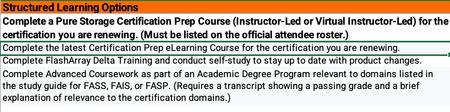
Hey gang, If any of you currently hold a Flash Array certification there is an alternative to retaking the test to renew your cert. The Continuing Pure Education (CPE) program takes into account learning activities and community engagement and contribution hours to renew your FA certification. I just successfully renewed my Flash Array Storage Professional cert by tracking my activities. Below are the details I received from Pure. Customers can earn 1 CPE credit per hour of session attendance at Accelerate, for a maximum of 10 CPEs total (i.e., up to 10 hours of sessions). Sessions must be attended live. I would go ahead and add all the sessions you attended at Accelerate to the CPE_Submission form. Associate-level certifications will auto-renew as long as there is at least one active higher-level certification (e.g., Data Storage Associate will auto-renew anytime a Professional-level cert is renewed). All certifications other than the Data Storage Associate should be renewed separately. At this time, the CPE program only applies to FlashArray-based exams. Non- FA exams may be renewed by retaking the respective test every three years. You should be able to get the CPE submission form from your account team. Once complete email your recertification Log to [email protected] for formal processing.1.1KViews4likes1CommentPure1 Manage Assessment
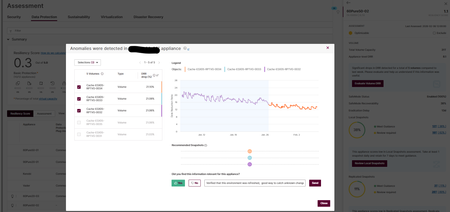
Hey Cincy PUG, I found a cool feature for detecting changes on your Flash Array. Looking at Data Protection under the Assessment menu I saw a lightning bolt on one of my arrays. That lightning bolt led me to an evaluation showing that there had been a significant drop in DRR for a group of volumes. Turns out that change was benign because one of my teammates refreshed an environment causing the change in the Data Reduction Ratio. I see this as just another way Pure 1 Manage can help admins detect threats or problems with data sets. How are you using the tools in Pure1? Share something with the group! -Charles153Views2likes0CommentsWe are just one week away PUG#3
January 28th, the Cincinnati Pure User Group will be convening at Ace's Pickleball to discuss Enterprise file. We will be joined by Matt Niederhelman Unstructured Data Field Solutions Architect to help guide conversation and answer questions about what he is experiencing amongst other customers. Click the link below to register and come join us. Help us guide the conversation with your ideas for future topics. https://info.purestorage.com/2025-Q4AMS-COMREPLTFSCincinnatiPUG-LP_01---Registration-Page.html87Views1like0Comments