PHIF: Modular Hypervisor Integrations and a VMware Migration Path That Doesn't Depend on VDDK

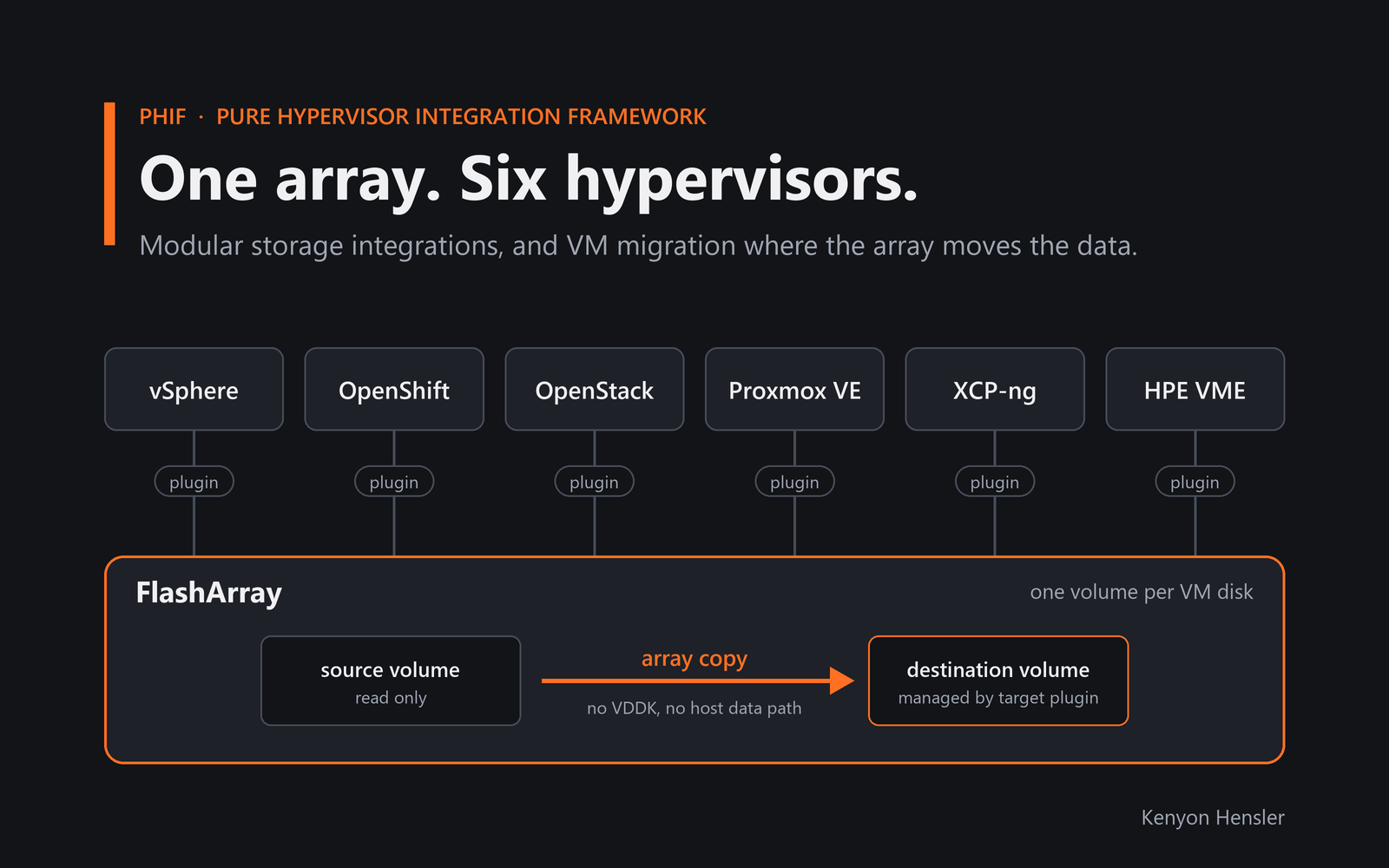
I've been building an open-source framework that connects FlashArray to six different hypervisors. Along the way it picked up a way to migrate VMs where the array moves the data, with no VDDK in the path.
This post first ran on my personal blog, vSkeeBall. The code is on GitHub at PureStorage-OpenConnect/pure-hypervisor-integration-framework.
For most of my career, virtualization meant VMware. Storage vendors built their integrations for vSphere, backup tools were built around VMware's APIs, and migration tools treated VMware as a source by reading its virtual disks and copying the blocks somewhere else.
That's not the world most of the customers I talk to live in anymore. They're running vSphere next to OpenShift Virtualization, Proxmox VE, XCP-ng, HPE VM Essentials or OpenStack, and sometimes several of those at once.
Some of the assumptions under the old tooling are changing too. In August 2026 Red Hat documented that VMware's Virtual Disk Development Kit (VDDK) images are no longer on the old public download, and you now have to request access from VMware/Broadcom. One workaround Red Hat called out was storage offload/XCOPY. Microsoft's Azure Migrate docs say the agentless VMware appliance needs VDDK too, and if you can't get it, you should use agent-based migration instead.
I'd already been chewing on a question that this made a lot more relevant: what if moving a VM didn't depend on pulling its data out through the source hypervisor's disk SDK at all?
That question ended up being one of the more interesting parts of PHIF, the Pure Hypervisor Integration Framework.
PHIF started with a simpler goal. I wanted an easier way to hook a FlashArray up to a bunch of different virtualization platforms. Over time it turned into an experiment around three questions:
- Can the hypervisor storage integrations be modular and useful on their own, with no management framework at all?
- Can one capability-driven control plane automate those integrations without becoming something you're stuck with?
- Once the hypervisors share the same storage, can the array itself become the migration path?
From what I've built so far, I think the answer to all three is yes.
One thing up front: PHIF is a side project of mine, not a supported Everpure product. There's more on that at the end.
Every hypervisor wants storage differently
Going in, I figured this was mostly an API problem. The APIs turned out to be the easy part. The hard part is that every platform has its own idea of what storage looks like:
- VMware has VMFS, vVols, NFS and RDMs.
- OpenStack wants storage through Cinder.
- OpenShift and Kubernetes want CSI.
- Proxmox has its own storage plugin model.
- XCP-ng has Storage Repositories and SMAPI.
- HPE VM Essentials is built on Morpheus and KVM, with yet another plugin model.
You could hide all of that behind one lowest-common-denominator layer, but you'd throw away most of what makes each platform worth running. So PHIF standardizes the orchestration and lets each platform keep its native integration model.
PHIF can connect a FlashArray, deploy or configure the right integration for each platform, manage credentials, run day-2 operations and coordinate VM migrations, without pretending the platforms are the same underneath.
Capabilities instead of if-statements
Each hypervisor in PHIF is a connector, and the connector declares what that platform supports. The capability list right now looks like this:
CONNECT, DEPLOY_PLUGIN, CONFIGURE, HOST_REGISTER, CONNECTIVITY,
PROVISION_DATASTORE, PROVISION_VOLUME, SNAPSHOT, CLONE, RESIZE,
QOS, REPLICATION, HEALTH, REMOVE, VM_INVENTORY, VM_LIFECYCLE, MIGRATE
The front end doesn't carry a pile of "if it's vSphere, show these buttons" logic. It shows whatever each connector says it implements. Adding a hypervisor mostly means writing a new connector. The registry finds it on its own, and the shared services (FlashArray client, job engine, secrets and log streaming) are already there.
This is one of my favorite screens in the app. All six platforms show up as peers, even though they look nothing alike under the hood.
You don't need PHIF to use the plugins
This is the part I care about most. PHIF can install the integrations, configure them, manage their lifecycle and use them in a migration, but several of them can be installed by hand and run without PHIF at all. I didn't want PHIF sitting between the hypervisor and the array. It sits above the integration instead:
PHIF
  |  deploy / configure / manage
  v
Hypervisor
  |  native plugin
  v
FlashArray
PHIF is an orchestration plane. It isn't in the VM's I/O path, and the storage integration keeps working if PHIF goes away.
So if all you want is better FlashArray integration on Proxmox, XCP-ng or HPE VM Essentials, just grab that plugin. You don't have to run the web app or touch migration.
Proxmox
For Proxmox I wrote a custom purefa storage type as a real PVE::Storage::Plugin, so it runs inside Proxmox's own storage framework. The model is one FlashArray volume per VM disk. Instead of one big shared LUN with LVM on top and guest disks carved out of it, every guest disk gets its own volume:
VM 101
  |-- disk-0 -------- FlashArray volume A
  |-- disk-1 -------- FlashArray volume B
VM 102
  |-- disk-0 -------- FlashArray volume C
Those volumes show up in the VM as raw multipathed block devices. Snapshots and clones happen on the array, and each disk keeps its own identity there.
None of that needs PHIF. You can install the plugin, define the storage, set up multipathing and register the hosts yourself. PHIF just automates those steps.
XCP-ng
XCP-ng needed a completely different implementation, built on SMAPIv3: a volume plugin for the FlashArray-backed VDI lifecycle, a datapath that hands the raw multipathed device to the VM, and a host component for things like cleaning up multipath maps.
Same idea as Proxmox, though: one VDI, one FlashArray volume, with snapshots and clones done on the array. I've validated it on a live two-host pool. PHIF can deploy it across a pool, or you can install it on the hosts yourself.
HPE VM Essentials
VME is Morpheus plus KVM, so this one is a native Morpheus/VME storage plugin. It registers FlashArray storage inside VME and lets VME drive the per-disk operations, with one volume per VM disk and snapshot, clone and resize offloaded to the array. I've validated it on a live VME appliance. PHIF can upload and configure it, or you can build and install it by hand.
vSphere, OpenShift and OpenStack
These three already had integrations: the FlashArray Cinder driver, Portworx CSI, and the vSphere plugin with VASA, VMFS and vVols. PHIF automates deploying and configuring them, and after that Cinder is still Cinder and CSI is still CSI. I don't want PHIF to fix one lock-in problem by adding a new mandatory dependency.
How I think about the layers
Layer 1   Native storage integration
Layer 2   Deployment and configuration automation
Layer 3   Lifecycle and day-2 operations
Layer 4   Cross-hypervisor orchestration and migration
Layer 1 is useful by itself, and you can stop there. Each layer above it is optional. Migration works because the storage model underneath is already there, but the plugins don't exist just to enable migration. Remove PHIF and they keep running. You lose the automation, not the storage integration.
The management layer
Nothing exotic here. It's a React SPA in front of a FastAPI backend, with an auto-discovered connector registry, a shared FlashArray REST client, an async job engine and encrypted credential storage. Operations run over HTTP APIs, SSH, Ansible or Kubernetes tooling.
It runs under Docker Compose or Kubernetes/Helm. There's also a mock mode that stubs out the array and hypervisor I/O, so you can walk through every workflow without any real infrastructure.
Day-2 operations
PHIF exposes whatever each connector implements as day-2 operations: host registration, connectivity, provisioning, snapshots, clones, resize, QoS, replication, health checks and plugin lifecycle, depending on the platform.
The UI is organized around six workflows: FlashArrays, API keys, hypervisors, operations, migrations, and jobs/log history. PHIF still stays out of the data path.
The deployment wizard
A lot of PHIF's value is just replacing a stack of per-platform install runbooks with one repeatable flow: discover the environment, find the nodes and interfaces, install the integration, set up storage networking, register the hosts, connect the FlashArray and validate.
If you only run one environment, you probably don't need the wizard. That's the point of keeping the integrations modular.
Then the storage layer became the migration layer
I didn't set out to build migration. It came out of the storage design. Once several hypervisors keep each VM disk as its own FlashArray volume, a cross-hypervisor migration starts to look very different.
The usual picture has the migration software acting as the data mover:
Source hypervisor
  -> virtual disk
  -> migration software (read blocks, transfer blocks)
  -> destination storage
  -> destination hypervisor
But if both platforms are attached to the same FlashArray, the source disk is already sitting on the hardware that's going to serve the destination. In a lot of cases there's no reason to copy it through a migration server.
So PHIF captures the source VM's logical configuration, creates a matching VM and managed disks on the destination, and fills those destination volumes with a FlashArray copy-with-overwrite. The source volumes stay the source of the data, and the big block copy happens inside the array instead of going through the migration host.
              PHIF orchestration
Source VM                          Destination VM
    |                                    |
    v                                    v
Source FA volume --- array copy ---> Destination FA volume
                 (inside FlashArray)
PHIF coordinates. The array moves the data.
Copy vs. move
PHIF supports both. In copy mode, the source VM stays put while PHIF builds the destination and copies each source volume into a destination-managed volume. In move mode, the source is shut down first and only removed once the destination is created and running.
If a migration fails, PHIF cleans up the half-built destination, and in copy mode the source is never touched. I've run boot-confirmed migrations in both directions across all the migration-capable platforms sharing one FlashArray.
To be clear, this doesn't hand the same LUN from one hypervisor to another. The destination plugin creates its own volume and the array copies into it, so each platform keeps its own ownership and naming.
Migration groups and scheduling
Once single-VM migration worked, I added groups, with a shared source and destination, network mapping, scheduling and concurrency controls. That still sits above the plugins, and the plugins don't need it.
Why VDDK matters here
VDDK is how third-party tools have traditionally read VMware virtual disks. It works, but it puts VDDK squarely in your migration path:
VMware VMDK -> VDDK -> migration software -> destinationIf your migration tool needs VDDK to read the source disk, its version compatibility, licensing and availability are all your problem.
PHIF's VMware migration doesn't use VDDK. I didn't build it that way because of the August change. It's a side effect of leaning on the array and VMware's own host tooling instead.
PHIF still uses the hypervisor APIs for the VM config, NICs and MACs, network mappings and creating the destination VM. It just doesn't pull the bulk data out through VDDK.
RDMs are the easy case
An RDM already has an identity as a storage device. PHIF resolves its device ID against the FlashArray, finds the volume, and that volume goes straight into the array-based workflow.
VMFS takes more work
A VMDK on VMFS is a file. The array holds the datastore, but there's no dedicated volume behind each individual VMDK, so PHIF has to change how the storage is represented.
For a VMFS source, PHIF provisions a new FlashArray volume, presents it to ESXi as an RDM, and clones the VMDK onto it with vmkfstools. Where the VMware storage path supports it, that clone is VAAI/XCOPY offloaded to the array.
Before:      VM -> VMDK file -> VMFS -> FlashArray datastore volume
Prep:        VMDK file --(vmkfstools / VAAI-XCOPY)--> dedicated FA volume
Migration:   dedicated FA volume --(FlashArray copy)--> destination-managed FA volume -> destination VM
No VDDK required. I also find it interesting that Red Hat independently pointed to storage offload/XCOPY as a way around its own VDDK dependency.
vSphere as a destination
vSphere can be the destination too. By default PHIF attaches the destination disks as virtual-mode RDMs backed by dedicated FlashArray volumes, which keeps the volume-per-disk model.
If you'd rather end up with native VMFS VMDKs, there's an optional conversion. That step is different, because going from a raw device into a file on VMFS does need host-side data movement. PHIF runs it with VMware's storage operations and verifies the result before it frees the temporary volumes.
That matters to me. An abstraction should make things simpler, but it shouldn't hide where the bytes are actually moving.
Let the hardware do what it's good at
Arrays already have snapshots, volume copies, clones, host mappings, replication and QoS. We think of those as storage features, but a lot of them work as mobility tools too. A volume copy can copy a VM disk, and a snapshot gives you a rollback point. So why push all the data through a migration appliance when the array that already owns it can do the copy?
I think the VDDK situation points at a bigger issue. If leaving platform A requires a proprietary disk-access SDK from platform A, that SDK is part of your portability strategy whether you planned for it or not.
PHIF splits the work. The hypervisor handles what it understands (inventory, CPU and memory, firmware, power state, networks and VM creation), and the array handles the volumes, copies, mappings and data.
Who owns the VM?
This project has also changed how I think about VM ownership. We usually draw the hypervisor on top, owning everything down to the array. I've started thinking of it as two halves: the compute platform owns the VM config and runs it, and the array owns the durable data that any of these hypervisors can consume. Real migrations still have plenty of complications (boot modes, drivers, disk formats, networking), but the data doesn't have to belong to one hypervisor.
What PHIF is, and what it isn't
PHIF is an independent, experimental project. It is not a supported Everpure product, and it isn't covered by a support agreement, warranty or SLA.
That matters because it does real things to real infrastructure. It can create and destroy array volumes, change storage connectivity and multipathing, apply Kubernetes components, and create, power off or delete VMs. Try it in a lab, start in mock mode, and only point it at data you can afford to lose. The custom Proxmox, XCP-ng and HPE VM Essentials plugins are just as experimental.
I put the code out so people can look at it, test it, change it and hopefully make it better.
Where it stands today
As of right now, PHIF has connectors for six environments: vSphere, OpenShift, OpenStack, Proxmox, XCP-ng and HPE VM Essentials. Each integration has been validated on hardware, and the migration engine has been tested on live hardware between the migration-capable platforms sharing the same FlashArray.
That's enough to prove out the architecture. Next I'd like to add more hypervisors through the connector model and see whether array replication opens up cross-array mobility. And since it's modular, you can reuse the one piece you like without buying into the rest.
Wrapping up
For me, the interesting part of PHIF isn't the UI or the migration wizard. It's how the work is split underneath: the integrations are the foundation, PHIF handles orchestration, and the array is the data plane. When everything shares the same array, you can ask what the storage hardware can do for you.
The VDDK changes made that more timely, but they aren't why I built it this way. They just show why those dependency boundaries matter.
Sometimes a hypervisor migration really does mean moving a lot of data. But when the source and destination share capable storage, the migration server doesn't have to be the thing doing the moving.
The source code, docs, deployment instructions, connector guides and the standalone plugins are all on GitHub: PureStorage-OpenConnect/pure-hypervisor-integration-framework. If you give it a try, I'd like to hear how it goes, so drop a comment here or open an issue on the repo.
PHIF is an independent experimental project. It is not a supported Everpure product, is not covered by a support agreement, warranty or SLA, and can perform destructive infrastructure operations. Test it only in environments and against data you can afford to lose.