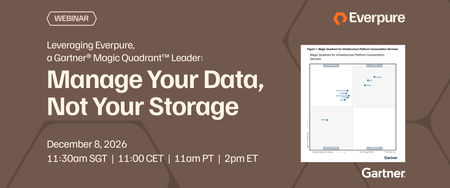
Leveraging Everpure, a Gartner® Magic Quadrant™ Leader: Manage Your Data, Not Your Storage
December 8 | 11:30am SGT | 11:00 CET | 11am PT | 2pm ET | Register Now Everpure has been named a Leader in two 2026 Gartner® Magic Quadrant™ reports (Enterprise Storage Platforms and Infrastructure Platform Consumption Services). We believe these results reflect a shift in how enterprises buy and run infrastructure: from managing individual storage arrays to managing data as a unified asset. In this session, the Arkansas Department of Transportation and Expedient will join our Everpure product marketing leader, Mike Adams, to show what that shift looks like in practice. They will show how they leverage Everpure as well as tie in with our Enterprise Data Cloud (EDC) architecture to support their workloads and overall business outcomes. Finally, the customers will also explain the choices they make when evaluating running CapEx and OpEx models. Attendees will: Learn how we feel the Gartner® evaluation criteria connect to outcomes customers feel every day See specific customer examples that walk through how they moved from silo-by-silo storage management to a unified data environment Get practical lessons on data governance, cyber resilience, and preparing data for AI workloads Whether you run storage today or are building an AI data strategy, this session shows how Everpure delivers a platform and vision that manages data for you. Register Now!10Views0likes0CommentsFaster Storage, Stubborn Redo: An Availability Group Story
Upgrading to faster hardware for your databases is exciting. Yes, it’s a lot of work, but you know your users will love the speed. So what happens when it isn’t faster? You’ve checked the legacy code for locking issues, implicit conversions, and compatibility problems, and you’re still stuck. What if the storage is performing exactly as expected, yet your SQL Server Availability Groups can’t keep up? That’s the story in the next edition of Data Under Pressure: Faster Storage, Stubborn Redo: An Availability Group Story. During a real-world migration to Pure Storage, John Morehouse hit an unexpected problem with SQL Server 2022 Enterprise Availability Groups. Redo queues kept growing, redo rates wouldn’t increase, and everything pointed to something stuck inside SQL Server. In this session, he will: Retrace the investigation step by step Walk through the test workload he used Show the metrics that exposed the bottleneck Explain the fix and what the team discovered along the way You’ll see why faster storage doesn’t always mean faster redo, and how seemingly unrelated configuration choices can affect Availability Group performance. Expect a real troubleshooting story with surprises, lessons learned, and techniques you can use the next time your availability groups are under pressure. Register to Join us Nov 18, 9am PST: Registration Page12Views0likes0CommentsAI Can Write Your Data Platform. Who’s Going to Keep It Running?
AI can write SQL, generate pipelines, build infrastructure, create database migrations, and even diagnose production problems. But what happens when it confidently does the wrong thing? As AI becomes part of how we build and operate modern data platforms, the key question is no longer just, “Can AI generate this?” It’s whether we can trust the result, deploy it safely, observe what happens, and recover when things go wrong. Join Hamish Watson for a practical session on bringing AI-assisted development into production reality. Drawing on experience across SQL Server, cloud platforms, Databricks, and database DevOps, Hamish will explore how version control, CI/CD, automated testing, drift detection, observability, and governance help keep AI-generated changes safe and recoverable. The session will include practical examples, lessons learned, and a live demo. And, because live demos rarely go exactly to plan, there may even be a surprise or two. AI might be able to write your data platform. The more important question is: who’s going to keep it running? Register for the session31Views0likes0Comments
Oracle Resiliency: Choosing the Right Data Protection Approach for Every Failure
October 1 | Register Now Oracle recovery requires more than a backup strategy. Accidental deletion, logical corruption, infrastructure failure, site loss, and ransomware demand different combinations of backup, snapshots, and replication. This session explains where each data protection layer does and doesn’t belong in an Oracle recovery architecture. Through practical failure scenarios, we’ll examine how to align RPO, RTO, retention, availability, and recovery-location requirements with the right recovery mechanism. You’ll also learn how to identify overlap, avoid common recovery gaps, and use storage automation to apply consistent protection policies across production, development, test, and DR environments. Session takeaways: Map Oracle failure scenarios to the appropriate data recovery mechanism. Identify protection overlap, operational complexity, and recovery gaps before an incident exposes them. Translate workload requirements into practical RPO, RTO, retention, availability, and recovery-location decisions. Register Now!60Views0likes0CommentsWhy Enterprises Still Need an Ontology
Data Under Pressure User Group Join us for a session with Argenis Fernandez, Distinguished Engineer at Nike, on Why Enterprises Still Need an Ontology. 📅 September 23, 2026 | 9:00 AM PST 🔗 Register: https://purestorage.zoom.us/webinar/register/WN_sK9Bkfz6QrmXxXKzLBzTCw#/registration What you'll get: Why talking the same language across your org matters A walk through the four-layer enterprise data stack A 4-cell rubric for evaluating your own ontology layer Don't miss this one if you're thinking about data architecture, governance, or how to get teams speaking a common language.122Views1like0CommentsActionable Assessments: Prepare Your Infrastructure for Oracle 26ai
August 20 | Register Now As organizations adopt Oracle AI Database 26ai with capabilities like AI vector search, understanding whether their existing data infrastructure can support these new workloads becomes increasingly important, while keeping costs under control. Join us as we explore how to analyze peak workload concurrency, optimize storage redundancy, and map advanced feature dependencies. Attendees will walk away with an actionable framework for evaluating their own environment, including access to a complimentary, privacy-first Everpure readiness assessment to help automate the planning process. Key takeaways: See your true workload and capture a consolidated, hour-by-hour view of peak demand. Crush storage bloat and learn how real-world environments are safely shrinking their storage footprints. Learn how to align infrastructure for active features like TDE, HCC, and Smart Scan without over-buying hardware. Secure your assessment and get exact sizing recommendations. Register Now!83Views0likes0Comments
Navigating the Tsunami, Reshaping the Data Industry
August 18 | Register Now! For August 2026, host Andrew Miller invites Andy Yun to Coffee Break. As a DBA himself with a long career in the data + database field, Andy now talks to Everpure customers (or sometimes “future customers”) every day about data and database challenges and solutions. We’ll wander through: Andy’s history with key mentoring lessons (both those he has learned and has helped others with), the value of soft skills in a deeply technical role, and why a solution architect works at Everpure. Database & DBA landscape - simultaneously keeping up “business as usual” while adapting to the AI tsunami that’s here whether we like it or not. Andy’s top DBA & database tips on Everpure from chatting with DBAs and customers every day. What’s new in the data landscape at Everpure - everything from an Oracle 26ai readiness assessment, to mind-blowing SQL backup throughput numbers, to how recent Everpure acquisitions impact you. Register Now!85Views0likes0CommentsThe Future of Intelligent Data Platforms: AI-Powered Search in SQL Server 2025
July 23 | Register Now! Semantic search allows applications to find relevant information based on meaning, rather than exact words. In this session, we'll look at how SQL Server 2025 implements this technology using native vector support and demonstrate how it can be used to build intelligent search experiences. You’ll see practical examples for generating, storing, and querying vectors, plus guidance on evaluation and performance trade-offs. Attendees will leave with an actionable plan to pilot semantic search and measure impact in their environment. Here is what to expect: Understand how vector search differs from keyword search Generate and store embeddings in a repeatable workflow Perform semantic searches using SQL Server's vector capabilities Evaluate performance impacts of vector indexes Register Now!168Views0likes0CommentsSee It Before It Happens: Predict and Fix Infra Issues Early
June 25 | Register Now! Database and infrastructure teams often struggle to predict how changes will affect application real-world performance, capacity, and service levels. Without clear visibility into where applications are running and how they consume resources, even small adjustments can introduce unexpected latency, IOPS bottlenecks, or capacity shortfalls, making troubleshooting slower and increasing the risk of missing SLAs. Join us and learn how to: Use scaling simulations to predict impacts on latency, IOPS, and capacity before changes are made. Apply data intelligence to identify where applications are running and how they consume resources. Improve performance planning and reduce troubleshooting time while maintaining stronger adherence to SLAs. Register Now!246Views0likes0Comments