Everpure Protect - Tools for Network Configuration
A key workflow item, especially when building Isolated Recovery Environments (IRE), Clean Rooms, test or production Disaster Recovery, or any other environment personality, is to reconfigure the network. Doing so automatically and per a plan is important to an automated, fast, and predictable workflow. We have built Everpure Protect Tools, which is a lightweight tool, registered with VMtools within a guest, that allows us to automate network configuration changes, per the individual Recovery Plan. Included in the download is a Powershell script for Windows, or a Shell script for Linux/Unix, which registered our tool with VMtools to perform the changes. The scripts can be loaded and ran manually in each guest, or distributed and executed as part of a workflow such as Microsoft MCM/SCCM. Everpure Protect Tools Once deployed, network changes on a per-VM or per-Recovery Plan basis will be automatically performed based upon the unique settings in the Recovery Plan being executed.713Views1like0CommentsLayered Resilience
Accelerate 2026 is approaching, and I’ve been preparing to speak on a cyber resilience panel. It’s prompted me to reflect on how prepared my organization really is—and I’m curious where others stand. This topic is never far from the headlines and feels like a great discussion point for this community or even a future meet-up. Here’s a snapshot of the layers we currently have in place: Immutable local Snapshots Immutable replication to a secondary site SRM Local WORM copy backups Auxiliary long-term WORM backups Air-gapped replication copy Investigating Cloud snap and Pure Protect This doesn't even include other tools like Varonis, Defender, Cortex...etc. What layers are you implementing today, and what are you working on to better protect your data? Sharing our successes and failures makes us all stronger! -Charlie632Views3likes1Comment
Why Cyber Resilience Requires Recovery Not Just Backups: CISO and Field Perspectives
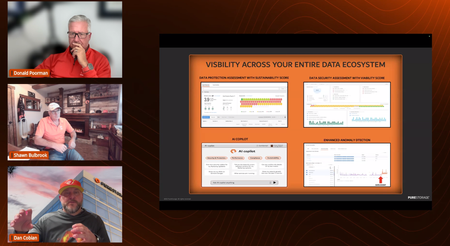
15 Minutes---Webinar from Everpure's Rick Orloff, CISO, and Scott Taylor, Director of Cyber Resilience Field Solution Architects on Cyber Recovery Strategy Resilience isn't just prevention—it’s about the "Minimum Viable Business." At RSAC 2026, Everpure’s Rick Orloff and Scott Taylor explained why recovery fails without understanding dependencies. Prioritize critical data and cross-functional collaboration to minimize revenue disruption. Stop treating backup as the goal; make rapid, strategic recovery your mission. Link to Webinar425Views1like0CommentsPure Protect - What Do I Need For Initial Setup With FlashArray?
Gathering the details needed for installation, and reviewing the steps before hand, are an important part of any implementation. With Pure Protect v2.6, there are a few details to review and gather to ensure your deployment goes smoothly. Review the Quick Start Guide on the Pure1 Support Portal Review and verify or modify your firewall rules to support Pure Protect communication & workflows Create a vCenter user in each vCenter you will be connecting as a Site, which should be at least 2. You may use an administrative service account, or a limited role service account as defined in our vCenter Roles/Permissions document on the Pure1 Support Portal Verify that vSphere/vCenter is at v 7.0 or higher Verify that any FlashArrays that will be managed are at 6.6.3 or higher. Releases below 6.6.3 are not supported. Use the Pure1 NDU service for a quick, easy, and painless upgrade! Connect the FlashArrays that will be used in source/target pairs. Best Practice details for configuring FlashArray replication should be reviewed, and reach out to your Systems Engineer or Principal Technologist if you have any questions. Complete the Pure Protect Pre-Install Checklist - reach out to your Cyber Resilience FSA and/or Systems Engineer for a copy with the full details. Details of the Pre-Install checklist needed for initial Site setup are here. Additional may be needed for configuration of Policies, Groups, and Plans. For Each FlashArray: Management IP Address & API Token. If you create an API token with an expiration, you will need to remember to rotate the token in the Pure Protect Site Configuration before it expires. For Each vCenter: Site Name DRaaS VM Management IP Address & DRaaS VM name Subnet Mask & Default Gateway Domain name DNS Server Quota (if also using non-FlashArray replication) We look forward to hearing how you are using Pure Protect!310Views2likes0CommentsData Intelligence and Cyber Resilience
Over the next few months you will be hearing more about data intelligence from Everpure. What is it? How is it relevant to cyber resilience? Data intelligence is the practice of transforming raw data into actionable insights through automated discovery, classification, and metadata analysis. In the modern threat landscape, it is the essential bridge between simple "backup" and true Active Resilience. Without intelligence, resilience is blind. Data intelligence provides the "who, what, and where" of your digital estate, allowing you to: Prioritize Recovery: Identify mission-critical applications and sensitive PII to ensure the most vital services are restored first. Accelerate Detection: Use AI-driven behavioral analysis to spot "silent" corruption or unauthorized access at the storage layer. Ensure Clean Restoration: Precisely tag compromised data to prevent re-infecting environments during recovery. By unifying data security with intelligence, organizations move from being passive targets to Active Defenders, ensuring operational survivability even in the face of sophisticated agentic attacks.224Views1like0Comments(3) Cyber Resilience Trends: In the News...
Recent industry coverage from SiliconANGLE, diginomica, and Coder Legion points to the same conclusion: in an era of AI-accelerated threats, organizations need a trusted recovery point at the storage layer. As Duncan Riley of SiliconANGLE wrote, Everpure is defining storage as the “last line of defense in modern cyber resilience,” with an architecture designed to protect recovery points even if an attacker gains administrative access elsewhere in the environment. That message was reinforced by coverage of a Fortune 100 recovery example in which attackers used stolen credentials and native tools, yet protected snapshots enabled revenue-critical operations to be restored in hours rather than weeks. The coverage also emphasized how AI is changing the threat landscape. diginomica noted that AI is compressing the window between vulnerability discovery and exploitation, forcing enterprises to rethink patching, resilience, and recovery timelines. Coder Legion captured the practical implication well: controls now need to hold up against attackers moving at machine speed, making out-of-band configuration and immutable snapshots increasingly essential. A third theme was the value of data context. Blocks & Files and SecurityBrief highlighted Everpure’s 1touch acquisition as an important addition to the cyber resilience story, helping organizations understand what data they have, where it lives, and what should be restored first. Together, these reports reinforce a broader shift in the market: cyber resilience is no longer just about preventing attacks, but about ensuring clean data, intelligent prioritization, and fast, confident recovery when the perimeter fails.212Views0likes0Comments
Active Cluster for File
Hello everyone :-) I'm new to Active Cluster for File and I'm looking for some documentation or introductory material. I'd like to understand: How Active Cluster for File works How it is configured via the management interface General setup, requirements, and administration tasks If anyone can point me to official documentation, knowledge base articles, or deployment guides, I would really appreciate it. Thanks!Solved200Views2likes5CommentsPure Protect v2.6 Released - With FlashArray Integration!
Pure has released v2.6 of Pure Protect //DRaaS, with FlashArray Integration! This release brings the ability for Pure Protect to directly manage a FlashArray backing datastores in VMware. Add your FlashArray's management IP and API key to Pure Protect, and you can start creating Policies that bring the RPO down to 15 minutes! No more needing to create array policies, replication groups or POD's, or other components. Pure Protect manages all of this for you, based upon an SLA Policy applied to an Application Group of Virtual Machines! RTO's are equally as fast, with Pure Protect orchestrating the replication, volume promotion, datastore creation, virtual machine registration, power on, and some reconfiguration if needed. With all of this being done on-array and via API's, RTO speeds and reduction of Work Recovery Times (WRT) will be unmatched! Reach out to your Pure team for details, or request a Community Edition via the Pure1 Catalog to try it out!135Views0likes0Comments