Where to get cyber news: Useful links.
Here are a number of publications I use to 'try' to keep up with everything happening in cyber security: https://thehackernews.com/ https://www.darkreading.com/ https://www.scworld.com/ https://www.securityweek.com/ https://www.cybersecuritydive.com/ https://www.infosecurity-magazine.com/204Views3likes0CommentsCyber Resilience Podcast - Live
Hey folks....I had the pleasure to sit down with John Gilroy from The Federal Tech Podcast to discuss Cyber Resilience Strategies for Federal customers from TechNet Cyber in Baltimore. There was even a fire alarm and evacuation 6 seconds into the recording. Live streaming, baby! Nothing like it :) Check it out! How Federal Agencies Can Achieve Cyber-Resilient Data Protection and Recovery Federal Tech Podcast - Episode 238145Views3likes0Comments
Zero Trust in Practice: What Actually Breaks in Real Environments
Most Zero Trust discussions sound great on paper—but implementation tells a different story. From recent hybrid deployments, here’s what actually breaks: Identity gaps Service accounts without MFA Legacy apps bypassing Conditional Access Device trust issues -Non-compliant endpoints still accessing critical apps -BYOD without proper posture checks Network assumptions Internal traffic still implicitly trusted Flat VLANs enabling lateral movement What worked well: Enforcing Conditional Access (device + user risk) ZTNA replacing VPN for application-level access -Micro-segmentation (Fortinet / host-based controls) Key takeaway: Zero Trust is not a product—it’s a continuous enforcement model across identity, device, and network layers.811Views2likes0CommentsFrom Passive to Proactive: A New Cyber Resilience Foundation
We are thrilled to announce a significant evolution of the Pure Storage Cyber Resilience solution, designed to transform your defense posture from passive to proactive. The announcements on September 25th deliver on three core pillars that are essential for modern defense: 1. Dynamic Response and Recovery: Recovery time must be measured in minutes, not days. We're introducing Pure Protect™ Recovery Zones to automatically provision Isolated Recovery Environments (IREs), plus a new Cyber Resilience delivered as a Service model with Veeam to guarantee instant, validated recovery. 2. Connected Detection: We’re eliminating security blind spots by embedding detection into the data layer itself. We have several new native detection capabilities and new integrations with CrowdStrike Real-Time Threat Graph and Superna Next-Gen SIEM to accelerate threat detection and remediation. 3. Built-in Security: Security is foundational. Our platform now features mandatory safeguards like TPM and UEFI Secure Boot and Enterprise-Grade Identity and Access Management to ensure the integrity of your platform from the ground up. See our Cyber Resilience announcement blog for more details.133Views2likes0CommentsRansomware’s Worst Nightmare: New Cyber Resilience Arsenal (new blog post)
With the barrage of new announcements coming out of NYC Accelerate, I wrote a new blog post that is relevant to all customers, but specific to State / Local Government and Education customers summarizing what is new and the value it brings in terms of Active Cyber Resilience. Your feedback is welcome: https://goo.gle/3xzWj8P z154Views2likes0CommentsModernizing Mainframe backups for Comprehensive Cyber Resilience Strategy
I've been talking to our Healthcare Payer customers, as well as almost all of the Fortune 500, about how Pure can help to incorporate Mainframe backup and recovery into their overall Cyber Resilience strategy. It is best practice to protect your data across the enterprise and with our Luminex + Pure solution, all your data can be protected under one plan. I'm interested to hear if anyone else is finding challenges with this process.157Views2likes0CommentsCan you recover?
How do you ensure you can recover from ransomware attacks and malicious incidents? Start with SafeMode. Is it enabled? Have you verified that all critical workloads and recovery environments are fully protected? Everpure FlashArray SafeMode provides immutable snapshot protection that helps organizations recover from ransomware attacks by preventing deleted snapshots or volumes from being permanently eradicated until a defined retention period expires — even if attackers compromise administrative credentials. SafeMode creates a storage-level immutability layer independent of operating systems, hypervisors, or backup software, helping preserve known-good recovery points for rapid restoration. Recommended best practices include enabling locked SafeMode through Everpure Global Technical Services, extending eradication timers to 14–30 days to account for delayed ransomware detection, implementing multi-person authorization for protected operations, and applying automated snapshot policies across critical workloads such as databases, virtual machine datastores, identity services, and backup repositories. Additional technical guidance and demonstrations are available through the SafeMode Documentation, SafeMode Introduction and SafeMode 101 (Tutorial).248Views1like0CommentsClaude Mythos: The Next Frontier of Autonomous Cyber Intelligence
Model Performance and Capabilities Claude Mythos represents a significant performance leap for Anthropic, reportedly beating their current best Opus model by a large margin. This kind of improvement hasn't been seen since OpenAI released their reasoning model O1 in September 2024. Key performance metrics include: Coding ability: 77% on SWE-Bench Pro (compared to Opus at 53%) Terminal usage: Substantial improvements in the model's ability to use terminal commands General purpose: Despite the cybersecurity focus in marketing, Mythos is a general-purpose LLM like other Claude models Cybersecurity Focus and Access Restrictions Anthropic has positioned Mythos around cybersecurity concerns, emphasizing AI as a potential national security risk - similar to OpenAI's approach with GPT-2 in 2019. However, the model is not cybersecurity-specific but rather a general-purpose AI. Limited Release Strategy: Anthropic has restricted access to select partners, most of whom are investors in the company: Microsoft (Series C and G investor) NVIDIA (Series G) JP Morgan (conventional loan, May 2025) Google (Series C and E, plus convertible debt) Amazon (Series D and E) Cisco (Series E) Market Implications and Competitive Advantages This restricted access creates what the video calls "privatization of tokens," giving certain companies advantages in: Cybersecurity: Finding vulnerabilities (benefiting companies like Cisco, Palo Alto) Legal services: Discovering legal loopholes and litigation strategies Finance and software development: Enhanced capabilities across various domains The core issue isn't cybersecurity itself, but rather the rapid improvement in AI capabilities outpacing society's ability to adapt. Infrastructure and Pricing Infrastructure Dependencies: Despite committing $50 billion to data centers in Texas and New York, Anthropic still relies on partners (Amazon, Google, Microsoft) for training and inference. Pricing Structure: Mythos will cost $125 per million output tokens Available through cloud APIs (Amazon Bedrock, Google Cloud Vertex, Microsoft Foundry) Unlikely to be included in subsidized Pro and Max plans Comparable to OpenAI's GPT-4 Pro at $180 per million tokens Business Strategy and Market Position IPO Positioning: The Mythos release strategically positions Anthropic for a potential IPO, with the company recently surpassing OpenAI by achieving $30 billion in annualized run rate (ARR) - though this is run rate rather than the more conservative annual recurring revenue metric. Adoption Challenges: The rapid advancement creates both excitement and concern, highlighting the growing divide between companies that adopt AI quickly and those that don't. The key is matching the right level of AI intelligence to appropriate tasks rather than using premium models for basic workflows. Future Outlook Based on historical patterns (like DeepSeek R1 catching up to OpenAI's O1 within 5 months), the performance gap created by Mythos will likely be bridged by competitors relatively quickly. The real competitive advantage lies in how quickly companies can adopt and properly allocate AI intelligence to solve complex problems.370Views1like0CommentsData Intelligence and Cyber Resilience
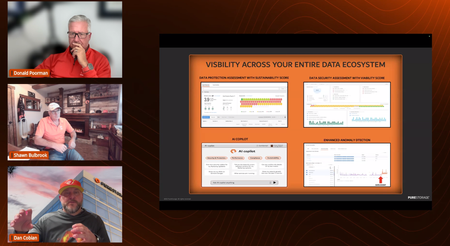
Over the next few months you will be hearing more about data intelligence from Everpure. What is it? How is it relevant to cyber resilience? Data intelligence is the practice of transforming raw data into actionable insights through automated discovery, classification, and metadata analysis. In the modern threat landscape, it is the essential bridge between simple "backup" and true Active Resilience. Without intelligence, resilience is blind. Data intelligence provides the "who, what, and where" of your digital estate, allowing you to: Prioritize Recovery: Identify mission-critical applications and sensitive PII to ensure the most vital services are restored first. Accelerate Detection: Use AI-driven behavioral analysis to spot "silent" corruption or unauthorized access at the storage layer. Ensure Clean Restoration: Precisely tag compromised data to prevent re-infecting environments during recovery. By unifying data security with intelligence, organizations move from being passive targets to Active Defenders, ensuring operational survivability even in the face of sophisticated agentic attacks.270Views1like0Comments