Announcing the General Availability of Purity//FA 6.9.2
We are happy to announce the general availability of 6.9.2, the third release of the 6.9 Long-Life Release (LLR) line and the thirteenth release based on the code line from 6.8! This LLR line provides long-term maintenance of the complete feature set introduced in the 6.8 Feature Release Line, including Fusion, with consistency in capabilities, user experience, and interoperability. This release includes support for R5 Controllers for FlashArray //X and //C, bringing performance, density, and data protection improvements to the 6.9 LLR line. For more detailed information about bug fixes and security updates included in each release, see the release notes. UPGRADE RECOMMENDATIONS AND EOL SCHEDULE Customers who are looking for long-term maintenance of the complete 6.8 feature set are encouraged to upgrade to the 6.9 LLR. Customers who are looking for continued delivery of all the newest capabilities as soon as they are available should upgrade to the 6.10 Feature Release line. When possible, customers should make use of Self-Service Upgrades (SSU) to ease the process of planning and executing non-disruptive Purity upgrades for their fleet. The 6.9 LLR line is planned for development through June 2028. HARDWARE SUPPORT This release is supported on the following FlashArray Platforms: FA//X (R3, R4, R5), FA//C (R3, R4, R5), FA//XL (R1, R5), FA//E, FA//RC20, and Pure Storage Cloud Dedicated (PSCD) for Azure and AWS. The PSCD release may take up to a week to be available on the AWS Marketplace and Azure Marketplace. Note, DFS software version 2.2.5 is recommended with this release. LINKS AND REFERENCES Purity//FA 6.9 Release Notes Self-Service Upgrades Purity//FA Release and End-of-Life Schedule FlashArray Hardware and End-of-Support DirectFlash Shelf Software Compatibility Matrix FlashArray Capacity and Feature Limits FlashArray Feature Interoperability Matrix3.4KViews0likes0Comments
Hi Guys - a customer has pointed out some confusing information regarding FA, ESXi ISCSI and port binding
According to https://core.vmware.com/resource/best-practices-running-vmware-vsphere-iscsi#sec7262-sub12 port binding is unsupported if the FA has iscsi-interfaces in 2 subnets. On https://support.purestorage.com/Solutions/VMware_Platform_Guide/User_Guides_for_VMware_Solutions/FlashArray_VMware_Best_Practices_User_Guide/VMware_and_iSCSI_FAQs#NIC_Teaming_vs_Port_Binding.2C_which_should_I_use.3F|https://support.purestorage.com/Solutions/VMware_Platform_Guide/User_Guides_for_VMware_S[…]ay_VMware_Best_Practices_User_Guide/VMware_and_iSCSI_FAQs it is stated "So which should you use? The answer here is clear, port binding whenever possible. This is not only recommended as a best practice with Pure Storage but by VMware as well."Solved2.4KViews0likes12CommentsRelease notes for purity
When I look at the release notes for purity https://support.purestorage.com/FlashArray/FlashArray_Release/01_Purity_FA_Release_Notes/9929_Purity%2F%2F%2F%2FFA_6.1.x_Release_Notes#6.1.22_Release_Notes Notes it says "Addresses several CVEs. (PURE-267648, PURE-261137)" - I cannot find anything regarding PURE-267648 and PURE-261137. I have tried searching the CVE db, but there is nothing about 6.1.22 and fixed CVEs. Where do i find this information?Solved1.1KViews0likes3CommentsPure Certifications
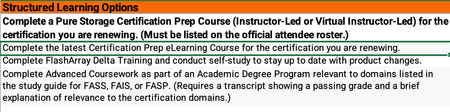
Hey gang, If any of you currently hold a Flash Array certification there is an alternative to retaking the test to renew your cert. The Continuing Pure Education (CPE) program takes into account learning activities and community engagement and contribution hours to renew your FA certification. I just successfully renewed my Flash Array Storage Professional cert by tracking my activities. Below are the details I received from Pure. Customers can earn 1 CPE credit per hour of session attendance at Accelerate, for a maximum of 10 CPEs total (i.e., up to 10 hours of sessions). Sessions must be attended live. I would go ahead and add all the sessions you attended at Accelerate to the CPE_Submission form. Associate-level certifications will auto-renew as long as there is at least one active higher-level certification (e.g., Data Storage Associate will auto-renew anytime a Professional-level cert is renewed). All certifications other than the Data Storage Associate should be renewed separately. At this time, the CPE program only applies to FlashArray-based exams. Non- FA exams may be renewed by retaking the respective test every three years. You should be able to get the CPE submission form from your account team. Once complete email your recertification Log to [email protected] for formal processing.1.1KViews4likes1CommentFlashArray File Multi-Server
File support on FlashArray gets another high demanded feature. With version 6.8.7, purity introduces a concept of Server, which connects exports and directory services and all other necessary objects, which are required for this setup, namely DNS configuration and networking. From this version onwards, all directory exports are associated with exactly one server. To recap, server has (associations) to following objects: DNS Active Directory / Directory Service (LDAP) Directory Export Local Directory Service Local Directory Service is another new entity introduced in version 6.8.7 and it represents a container for Local Users and Groups. Each server has it's own Local Directory Service (LDS) assigned to it and LDS also has a domain name, which means "domain" is no longer hardcoded name of a local domain, but it's user-configurable option. All of these statements do imply lots of changes in user experience. Fortunately, commonly this is about adding a reference or possibility to link a server and our GUI contains newly Server management page, including Server details page, which puts everything together and makes a Server configuration easy to understand, validate and modify. One question which you might be asking right now is - can I use File services without Servers? The answer is - no, not really. But don't be alarmed. Significant effort has been made to keep all commands and flows backwards compatible, so unless some script is parsing exact output and needs to be aligned because there is a new "Server" column added, there should be any need for changing those. How did we managed to do that? Special Server called _array_server has been created and if your configuration has anything file related, it will be migrated during upgrade. Let me also offer a taste of how the configuration could look like once the array is updated to the latest version List of Servers # pureserver list Name Dns Directory Services Local Directory Service Created _array_server management - domain 2025-06-09 01:00:26 MDT prod prod - prod 2025-06-09 01:38:14 MDT staging management stage staging 2025-06-09 01:38:12 MDT testing management testing testing 2025-06-09 01:38:11 MDT List of Active Directory accounts Since we can join multiple AD servers, we now can have multiple AD accounts, up to one per server # puread account list Name Domain Computer Name TLS Source ad-array <redacted>.local ad-array required - prod::ad-prod <redacted>.local ad-prod required - ad-array is a configuration for the _array_server and for backwards compatibility reasons, the prefix of the server name hasn't been added. The prefix is there for account connected to server prod (and to any other server). List of Directory Services (LDAP) Directory services got also slightly reworked, since before 6.8.7 there were only two configurations, management and data. Obviously, that's not enough for more than one server (management is reserved for array management access and can't be used for File services). After 6.8.7 release, it's possible to completely manage Directory Service configurations and linking them to individual servers. # pureserver list Name Dns Directory Services Local Directory Service Created _array_server management - domain 2025-06-09 01:00:26 MDT prod prod - prod 2025-06-09 01:38:14 MDT staging management stage staging 2025-06-09 01:38:12 MDT testing management testing testing 2025-06-09 01:38:11 MDT Please note that these objects are intentionally not enabled / not configured. List of Directory exports # puredir export list Name Export Name Server Directory Path Policy Type Enabled prod::smb::accounting accounting prod prodpod::accounting:root / prodpod::smb-simple smb True prod::smb::engineering engineering prod prodpod::engineering:root / prodpod::smb-simple smb True prod::smb::sales sales prod prodpod::sales:root / prodpod::smb-simple smb True prod::smb::shipping shipping prod prodpod::shipping:root / prodpod::smb-simple smb True staging::smb::accounting accounting staging stagingpod::accounting:root / stagingpod::smb-simple smb True staging::smb::engineering engineering staging stagingpod::engineering:root / stagingpod::smb-simple smb True staging::smb::sales sales staging stagingpod::sales:root / stagingpod::smb-simple smb True staging::smb::shipping shipping staging stagingpod::shipping:root / stagingpod::smb-simple smb True testing::smb::accounting accounting testing testpod::accounting:root / testpod::smb-simple smb True testing::smb::engineering engineering testing testpod::engineering:root / testpod::smb-simple smb True testing::smb::sales sales testing testpod::sales:root / testpod::smb-simple smb True testing::smb::shipping shipping testing testpod::shipping:root / testpod::smb-simple smb True The notable change here is that the Export Name and Name has slightly different meaning. Pre-6.8.7 version used the Export Name as a unique identifier, since we had single (implicit, now explicit) server, which naturally created a scope. Now, the Export Name can be the same as long as it's unique in scope of a single server, as seen in this example. The Name is different and provides array-unique export identifier. It is a combination of server name, protocol name and the export name. List of Network file interfaces # purenetwork eth list --service file Name Enabled Type Subnet Address Mask Gateway MTU MAC Speed Services Subinterfaces Servers array False vif - - - - 1500 56:e0:c2:c6:f2:1a 0.00 b/s file - _array_server prod False vif - - - - 1500 de:af:0e:80:bc:76 0.00 b/s file - prod staging False vif - - - - 1500 f2:95:53:3d:0a:0a 0.00 b/s file - staging testing False vif - - - - 1500 7e:c3:89:94:8d:5d 0.00 b/s file - testing As seen above, File network VIFs now are referencing specific server. (this list is particularly artificial, since neither of them is properly configured nor enabled, anyway the main message is that File VIF now "points" to a specific server). Local Directory Services Local Directory Service (LDS) is a newly introduced container for Local Users and Groups. # pureds local ds list Name Domain domain domain testing testing staging staging.mycorp prod prod.mycorp As already mentioned, all local users and groups now has to belong to a LDS, which means management of those also contains that information # pureds local user list Name Local Directory Service Built In Enabled Primary Group Uid Administrator domain True True Administrators 0 Guest domain True False Guests 65534 Administrator prod True True Administrators 0 Guest prod True False Guests 65534 Administrator staging True True Administrators 0 Guest staging True False Guests 65534 Administrator testing True True Administrators 0 Guest testing True False Guests 65534 # pureds local group list Name Local Directory Service Built In Gid Audit Operators domain True 65536 Administrators domain True 0 Guests domain True 65534 Backup Operators domain True 65535 Audit Operators prod True 65536 Administrators prod True 0 Guests prod True 65534 Backup Operators prod True 65535 Audit Operators staging True 65536 Administrators staging True 0 Guests staging True 65534 Backup Operators staging True 65535 Audit Operators testing True 65536 Administrators testing True 0 Guests testing True 65534 Backup Operators testing True 65535 Conclusion I did show how the FA configuration might look like, without providing much details about the actual way how to configure or test these configs, anyway, this article should provide a good overview about what to expect from 6.8.7 version. There is plenty of information about this particular aspect of the release in the updated product documentation. Please let me know if there is any demand to deep-dive into any aspect of this feature.1KViews2likes2Comments