Pure's Intelligent Control Plane: Powered by AI Copilot, MCP Connectivity and Workflow Orchestration
At Accelerate 2025, we announced two capabilities that change how you manage Pure Storage in your broader infrastructure: AI Copilot with Model Context Protocol (MCP) and Workflow Orchestration with production-ready templates. Here's what they do and why they matter. AI Copilot with MCP: Your Infrastructure, One Conversation The Problem Your infrastructure spans multiple platforms. Pure Storage managing your data, VMware running VMs, OpenShift handling containers, security tools monitoring threats, application platforms tracking performance - each with its own console, APIs, and workflows. When you need to migrate a VM or respond to a security incident, you're manually pulling information from each system, correlating it yourself, then executing actions across platforms. You become the integration layer. The Solution Pure1 now supports Model Context Protocol (MCP), taking Copilot from a suggestive assistant to an active operator. With MCP enabled, Copilot doesn’t just recommend - it acts. It serves as a secure bridge between natural language and your infrastructure, capable of fetching data, executing APIs, and orchestrating workflows across diverse systems. Here’s what makes this powerful: You deploy MCP servers within your environment—one for VMware, another for OpenShift, and others for the systems you use. Each server exposes your environment’s capabilities through a standard, interoperable protocol. Pure Storage AI Copilot connects seamlessly to these MCP servers, as well as to Pure services such as Data Intelligence, Workflow Orchestration, and Portworx Monitoring, enabling unified and secure automation across your hybrid ecosystem. What You Can Connect You can deploy an MCP server on any system whether it’s your VMware environment, Kubernetes clusters, security platforms like CrowdStrike, databases, monitoring tools, or custom applications. Pure Storage AI Copilot connects to these servers under your control, securely combining their data with Pure Storage services to deliver richer insights and automation. Getting Started: If you have a use-case around MCP, please contact your Pure Storage account team. Workflow Orchestration: Deploy in Minutes, Not Months The Problem Building production-grade automation takes months. You need error handling, integration with multiple systems, testing for edge cases, documentation, ongoing maintenance. Most teams end up with half-finished scripts that only one person understands. The Solution We built workflow templates for common operations, tested them at scale, and made them available in Pure1. Install them, customize to your needs, and run them in minutes. Key Templates VMware to OpenShift Migration with Portworx Handles complete migration: extracts VM metadata, identifies backing Pure volumes, checks OpenShift capacity, configures vVols Datastore and DirectAccess, uses array-based replication, converts to Portworx format. Traditional migration takes hours for TB-scale VMs. This takes 20 to 30 minutes. SQL / Oracle Database Clone and Copy Automates cloning and copying of SQL Server and Oracle databases for dev/test or refresh needs. Instantly creates storage-efficient clones from snapshots, mounts them to target environments, and applies Pure-optimized settings. The hours-long manual process becomes a quick, consistent workflow completed in minutes Daily Fleet Health Check Scans all arrays for capacity trends, performance issues, protection gaps, hardware health.Posts summary to Slack. Proactive visibility without manually checking each array. Rubrik Threat Detection Response When Rubrik detects a threat, automatically tags affected Pure volumes, creates isolated immutable snapshots, and notifies the security team. Security events propagate to your storage layer automatically. How It Works Workflow Orchestration is a SaaS feature in Pure1. Deploy lightweight agents (Windows, Linux, or Docker) in your data center to execute workflows locally. Group agents together for high availability and governance controls. Integrations Native Pure Storage: Pure1 Connector for full API access, Fusion Connector for storage provisioning (works for Fusion and non-Fusion FlashArray/FlashBlade customers) Third-Party: ServiceNow, Slack, Google, Microsoft,CrowdStrike, HTTP/Webhooks, Pagerduty, Salesforce and more. The connector library continues expanding. Getting Started: Opt-in now in Pure1 - Workflow. Introductory offer available at this time. Check with your Pure account team if you have questions. How They Work Together At Accelerate 2025 in New York, we showcased this capability in action. Here's the scenario: an organization wants to migrate VMs to Kubernetes. Action-enabled Copilot orchestrates communication with Pure Storage appliances and services as well as third-party MCP servers to collect the required information for addressing a problem across a heterogeneous environment. With Pure1 MCP, AI Copilot, and Workflows, there's now a programmatic way to collect information from OpenShift MCP, VMware MCP, and Pure1 storage insights- then recommend an approach on what VMs to migrate based on your selection criteria. You prompt Copilot: "How can I move my VMs to OpenShift in an efficient way?" Copilot communicates across: Your VMware MCP server - to get VM specifications, current configurations, resource usage Your OpenShift MCP server - to check available cluster capacity, validate compatibility Portworx monitoring - to understand current storage performance Copilot reasons across all this information, identifies ideal VM candidates based on your criteria, and recommends the migration approach- which VMs to move, target configurations, and how to preserve policies. Then it can trigger the migration workflow, keeping you updated throughout the process. Why This Matters Storage Admins: Stop being the bottleneck. Enable self-service while maintaining governance. DevOps Teams: Deploy production-tested automation without writing code. Security Teams: Build automated response workflows spanning detection, isolation, and recovery. Infrastructure Leaders: Reduce operational overhead. Teams focus on strategy, not repetitive tasks. Get Started MCP Integration:If you have a use-case around MCP, please contact your Pure Storage account team.. Workflow Orchestration:Opt-in at Pure1 → Workflows. Learn More: Documentation in Pure1 or contact your Pure Storage account team. Pure1 evolved from a monitoring platform to an Intelligent Control Plane. AI Copilot reasons across your infrastructure. Workflow Orchestration executes. Together, they change how you manage data with Pure Storage.1KViews2likes0CommentsPure Cloud Block Store is now Pure Storage Cloud Dedicated (PSC Dedicated)
Pure Storage Cloud Dedicated: Name Change, Same Enterprise-Grade Experience Pure Storage Cloud is an enterprise-grade block storage delivered as a service in the public cloud. It extends the data services and evergreen architecture of the Purity operating system and can be deployed in: Azure as a fully managed native service or a customer-managed service integrated with Azure VMware Solution (AVS) AWS as a customer-managed service integrated with Elastic VMware Service (EVS) What’s New? Pure Cloud Block Store, the customer-managed service, is being renamed Pure Storage Cloud Dedicated (PSC Dedicated). This change reflects its integration into the Pure Storage Cloud family and alignment with the Enterprise Data Cloud strategy. What’s Not Changing? Everything That Matters Your experience, performance, and features remain the same. Pure Storage Cloud Dedicated continues to provide: Enterprise Data Services: Purity software in Azure and AWS, with data reduction, thin provisioning, and snapshots. Cost Efficiency: Optimized storage usage and reduced footprint through data reduction. Reliability & Resilience: Built-in redundancy, high availability, and cyber resilience. Hybrid & Multi-Cloud Mobility: Consistent APIs and replication across FlashArrays and PSC Dedicated for migration, DR, and data mobility. Disaster Recovery & Backup: Asynchronous and near-synchronous replication, plus snapshots for cost-effective backup and rapid recovery. VMware Workload Support: Enterprise-grade storage for VMware in AVS and EVS environments. Why This Matters The shift from Pure Cloud Block Store to Pure Storage Cloud Dedicated unifies offerings under the Pure Storage Cloud umbrella while advancing the broader Enterprise Data Cloud strategy.399Views3likes0CommentsHealthcare Sessions at Accelerate 2026
Accelerate is almost here! 🙌 Check out our special track tailored for healthcare professionals. Hear from Everpure experts about the latest trends and strategies for data management success in healthcare. If this sounds right up your alley, we’ve curated a list of must-attend breakout sessions focused on all things Healthcare. Check out these don't miss sessions: Modernizing Epic Infrastructure: Performance, Flexibility, Resilience, and Virtualization Evolving Everpure Cloud Value: A Smarter Hybrid Cloud Approach for Healthcare Predictable Imaging Economics: Powering End-to-End Solutions with Price-per-Study Edge AI in Production: Real-Time Decision-Making in Sanofi’s Cryo-EM Core Will you be joining us in person? Drop a comment below with the session you're most interested in and what you hope to learn!308Views2likes0CommentsWhen Data Becomes the Mission
Why state and local government, cities, and research universities are reorganizing infrastructure around data itself If you remember one thing from this article: infrastructure used to organize around applications. Increasingly, now it organizes around data. If you spend enough time around enterprise infrastructure, you start to notice something about how conversations begin. Someone asks about storage. Not in a philosophical way. In a practical way. How much capacity do we have left? What’s the refresh cycle? Is this staying on premises or moving to cloud? What’s the backup strategy? For years, that framing made perfect sense. Infrastructure was the foundation, and the job of infrastructure teams was to keep the lights on and the foundation solid. But lately, in conversations with customers across state and local government, municipalities, cities, and universities, something feels different. Because eventually someone says something like this: “We have this data… but we can’t actually use it.” And that is when the real conversation begins. Why the public sector reveals the truth about data There’s a perspective I heard recently that stuck with me. The public sector isn’t a niche market. It’s a microcosm of the entire enterprise technology world. At first that sounds counterintuitive. The stereotype is that government IT has been quietly living under a rock since the previous century, next to a beige server and a stack of COBOL manuals. But if you look closely, the opposite is true. State agencies, cities, and research institutions operate in environments that combine nearly every architectural challenge the private sector faces — all at once. Massive datasets Highly distributed users Strict security requirements Long retention policies Global collaboration And an absolute requirement that systems remain available when people need them most. In other words, the public sector experiences the full spectrum of data challenges simultaneously. If you want to stress-test a data architecture, put it inside government. Think about it. A state government may run thousands of systems across dozens of agencies, each serving different missions but increasingly sharing the same underlying data. A city manages infrastructure at the physical edge of society — traffic, water, SCADA, emergency services — where real-time decisions depend on accurate information. Universities generate some of the largest research datasets on earth while collaborating across institutions and countries. Each of these environments demands something slightly different from infrastructure. But they all demand the same thing from data: Security. Integrity. Mobility. Context. Availability. And when those requirements collide in one environment, something interesting happens. The solutions that work there tend to work everywhere. A laboratory for the modern data enterprise This is why many technology leaders quietly view the public sector as something more than a vertical market. It’s a laboratory for enterprise-scale data architecture. If a platform can operate in a world where: sensitive personal data must remain protected • systems span thousands of locations • regulatory oversight is constant • and uptime has real public consequences …then that architecture will almost certainly succeed in commercial environments. Banks, manufacturers, healthcare providers, and global enterprises face the same challenges. Just rarely all at once. Government simply compresses those problems into a single environment. Solve the data problem for government, and you solve it for the enterprise. That’s one reason the shift toward data-centric platforms is becoming so important. When organizations treat infrastructure as a place to store files, they solve only a small part of the problem. But when they treat data as the central operational asset — something that must be understood, governed, protected, and made usable across environments — the architecture begins to look very different. And the public sector, with all its complexity, becomes the place where those architectures are tested first. Which brings us back to the shift we’re seeing across the industry. Because once you start looking at infrastructure through the lens of data itself, something else becomes obvious. The center of gravity has moved. When multiple systems depend on the same dataset, the data becomes part of the operating foundation. And once that happens, moving it — or even restructuring it — becomes dramatically harder. Which brings us to the concept that explains a lot of what is happening right now. The quiet physics of data gravity The first time I heard the term “data gravity” wasn’t in a conference keynote or a vendor presentation. It was in 2015, when a recruiter from a startup called DataGravity (now Anomalo) reached out and asked if I would be interested in interviewing. At the time, the idea sounded fascinating — and slightly theoretical. The company was built around the premise that data itself was becoming the most valuable asset in the data center, and that infrastructure needed to understand the content, context, and behavior of data, not just store it. The name alone hinted at something deeper: the idea that as datasets grow, they start exerting a kind of gravitational pull on the systems around them. Back then, it felt like an interesting concept. Today it feels like a description of reality. The term “data gravity” itself was introduced by Dave McCrory back in 2010, and it turns out to be a remarkably accurate way to describe modern infrastructure. Dave McCrory Blog The idea is simple. As datasets grow, they become harder to move. More applications depend on them. More workflows connect to them. More policies govern them. Eventually, the architecture starts organizing around the data itself. Not because someone designed it that way. Because the physics of large systems leave you very little choice. Imagine trying to relocate a state Medicaid dataset that has been integrated with multiple benefit programs, identity verification systems, and fraud detection tools. Technically possible? Sure. Operationally trivial? Not even close. The larger and more interconnected the dataset becomes, the stronger its gravitational pull. Compute moves closer to the data. Applications move closer to the data. Infrastructure reorganizes around the data. This is why organizations that once talked primarily about storage capacity are now talking about data platforms. The center of gravity moved. When data stops being passive The moment data becomes operational, everything changes. For years, most organizations treated data as something that accumulated quietly inside systems. Applications produced it. Storage kept it safe. Backups made sure it could be restored. But that model starts to break down when the data itself becomes part of real-time decision making. You can see this most clearly in environments that generate enormous volumes of information. Cities now run infrastructure that continuously streams telemetry — traffic sensors, utility meters, environmental monitors, emergency response platforms. A water meter that once reported usage once a month might now generate thousands of readings per year. A traffic system that once relied on static timing can adapt dynamically to real-time conditions. Each improvement creates more data. More importantly, it creates operational dependence on that data. Universities experience the same phenomenon in a different form. Research environments produce extraordinary datasets across genomics, climate science, and artificial intelligence. Sequencing a single human genome generates roughly 100 gigabytes of raw data, and large research programs may create terabytes or petabytes of new information every week. In those environments the challenge isn’t just storing data. It’s feeding it fast enough to the systems that depend on it. Modern research clusters and GPU environments can process enormous volumes of information, but only if the underlying data pipeline keeps up. When storage cannot deliver data fast enough, expensive compute resources sit idle and discovery slows down. And that reveals an important truth about modern infrastructure. When systems depend on data in real time, the question stops being where the infrastructure lives. The question becomes whether the data is available, trustworthy, and recoverable. That distinction also explains why ransomware has become so disruptive to public institutions. Attackers understand that the real leverage is not the servers or the network. It’s the data. When access to data disappears, the services built on top of it disappear as well. Which brings us back to the deeper shift happening across the industry. If data has become this central to operations, services, and discovery, then managing it as a passive byproduct of infrastructure is no longer enough. Infrastructure alone is no longer the strategic layer. The strategic layer is the data itself. Organizations still need performance, availability, and resilience. Those fundamentals have not changed. What has changed is the expectation that infrastructure should also help organizations understand, govern, protect, and use their data more effectively. That is a very different problem than simply storing it. And it is the reason the conversation is evolving from storage management to data management platforms. The real punch line Public sector organizations didn’t set out to become data enterprises. Over time the data accumulated. Then the dependencies formed. And eventually everything started orbiting the datasets that mattered most. Data has gravity. Data has risk. Data has power. Infrastructure still matters. But increasingly, the real mission is something else entirely. The mission is the data. Appreciate you reading. Dmitry Gorbatov © 2025 Dmitry Gorbatov | #dmitrywashere302Views0likes0CommentsJoin Everpure Cloud at Pure Accelerate 2026
If you're coming to Pure Accelerate, make time for the Everpure™ Cloud sessions. This year's lineup brings together breakout sessions, flash talks, and a community meetup focused on modern cloud storage across Azure and AWS, workload design, hybrid cloud strategy, and practical ways to improve cost efficiency and operational simplicity. Whether you're evaluating how to support Azure VMs at scale, looking for better patterns for hybrid workloads, or trying to bring more predictability to cloud storage costs, these sessions are designed to help you move from strategy to execution. Why attend the Everpure Cloud sessions? Cloud teams are under pressure to do more than just migrate. They need to control costs, simplify operations, and build architectures that can adapt as business needs change. At Pure Accelerate, the Everpure Cloud sessions will focus on exactly those conversations, with content spanning architecture, scale, FinOps, storage operations, and real-world workload guidance. This is a strong opportunity to hear how Everpure Cloud supports modern cloud environments across Azure, AWS, and hybrid use cases, while giving infrastructure teams more flexibility in how they scale and manage storage. Featured Everpure Cloud sessions at Pure Accelerate Breakout sessions Modern Azure Storage with Everpure Cloud: Architecture, Scale & FinOps — Thursday, June 18, 1:45–2:30 PM PT. Configuring Workloads for Everpure Cloud: Architectures, Patterns, and Gotchas — Thursday, June 18, 1:45–2:30 PM PT. Maximizing Hybrid SQL Server 2025 on Azure with Everpure Cloud — Wednesday, June 17, 2:45–3:30 PM PT. These breakout sessions are ideal for attendees who want a deeper look at architecture decisions, workload best practices, and ways to align cloud storage performance with cost and scale requirements. Flash talks Everpure Cloud Azure Native for Azure VMs in 15 Minutes — Thursday, June 18, 2:45–3:05 PM PT. Accelerating Storage Operations with Everpure Cloud — Thursday, June 18, 3:15–3:35 PM PT. Evolving Everpure Cloud Value: A Smarter Hybrid Cloud Approach for Healthcare— Thursday, June 18, 12:30–12:50 PM PT. Public Cloud Experience, Private Cloud Economics— Thursday, June 18, 12:00–12:20 PM PT. If you want high-value takeaways in a shorter format, these flash talks are a great way to quickly explore how Everpure Cloud can help streamline operations, support Azure VM environments, and improve the economics of cloud storage. Community session Community Meetup: You're Moving to the Cloud: Now What? — Wednesday, June 17, 5:30–6:30 PM PT. This meetup is a great fit for anyone looking to exchange ideas with peers, hear different perspectives on cloud adoption, and join a broader conversation around the challenges and opportunities that come with moving to the cloud. Meet the Everpure cloud team at booth If you're in Las Vegas for Pure Accelerate, stop by the Everpure Cloud showcase booth to continue the conversation in person and to learn how organizations are reducing storage costs, simplifying operations, and scaling hybrid cloud environments more efficiently. Learn more To explore the Everpure Cloud portfolio in more detail, visit the Everpure Cloud webpage. For deeper technical guidance, check out these Knowledge Portal resources: Everpure Cloud Dedicated for Azure documentation Everpure Cloud Dedicated for AWS documentation Everpure Cloud Azure Native documentation Add Everpure Cloud to Your Pure Accelerate Agenda If cloud cost optimization, operational simplicity, and scalable storage architectures are priorities for your team, be sure to add these sessions to your Pure Accelerate schedule. We look forward to seeing you there. Ready to join us in Las Vegas? Register now for Pure Accelerate 2026 and start building your agenda. We look forward to seeing you there.288Views2likes0CommentsAsk Us Everything: Evergreen//One™ Edition — What the Community Learned
A recent Ask Us Everything (AUE) session on Pure Storage Evergreen//One™ was a lively, deeply technical conversation—and exactly the kind of dialogue that makes the Pure Community special. Here are some of the biggest takeaways, organized around the questions asked and the insights that followed.225Views0likes0CommentsAccelerate London 2025
🚀 Pure Accelerate | London | Discover WHY we're leading the Gartner MQ. Hear from industry experts and customers on crushing their goals across AI, Cyber Resilience, Cloud, Databases, and Virtualisation strategy. This is our flagship innovation showcase.200Views1like0CommentsHow to Leverage Object Storage via Fuse Filesystems
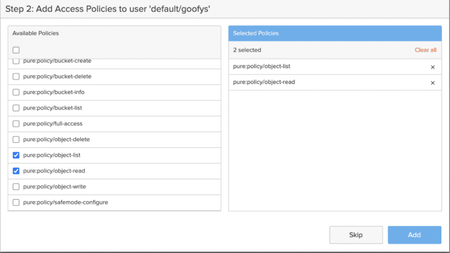
This article originally appeared on Medium.com and is republished with permission from the author. Cloud-native applications must often co-exist with legacy applications. Those legacy applications are hardened and just work, so rewriting can seem hardly worth the trouble. For legacy applications to take advantage of new technology requires bridges, and fuse clients for object storage are a bridge that allow most (but not all) applications that expect to read and write files to work in the new world of object storage. I will focus on three different implementations of a fuse-based filesystem on top of object storage, s3fs, goofys, and rclone. Prior work on performance comparisons of s3fs and goofys include theoretical upper bounds and the goofys GitHub readme. General guidelines for when to use a fuse filesystem adaptor for object storage: The application expecting files requires only moderate performance and does not have complicated dependencies on POSIX semantics. You are using the filesystem adaptor for either reads or writes of the data, but not both. If your application is both reading and writing files, then it’s best to use a real filesystem for the working data and copy only the final results to an object store. You are using the adaptor because one part of your data pipeline is an application that expects files, whereas other applications expect objects. If you find yourself primarily copying data between local filesystems and remote object storage, then tools like s5cmd or rclone will provide better performance. There is also a Python library s3fs with similar functionality, but despite the names being the same, they are distinct pieces of software. The Python version indeed makes access to objects much easier than direct boto3code but is not as performant due to the nature of Python itself. Of the three choices, I personally suggest using goofys due to significantly better performance. It may have less POSIX compatibility, but if that difference matters to your use case, then a fuse client might not be the right answer. Fuse Best Practices and Limitations First, a FUSE client is a filesystem client written in userspace. This is in contrast to most standard filesystem clients, like EXT4 or NFS, which are implemented in the Linux kernel. This leads to more flexibility to implement filesystems, including ones that only roughly resemble a traditional filesystem. It also means you can more easily mount fuse filesystems without root privileges. Conceptually, these fuse clients are lightweight client-side gateways that translate between objects and files. You could also run a separate server that acts as a gateway, but that incurs the additional cost and complexity of an extra server. A fuse client is most useful when one part of a workflow requires simple reading or writing files, whereas the rest of your workflow directly accesses objects via native S3 API. In other words, a fuse client is a tactical choice for bringing a data set and associated workflow from filesystem to object storage, where the fuse client specifically bridges the gap where an application expects to read or write files. Things to avoid when using a fuse client: Do not expect ownership or permissions to work right. Control permissions with your S3 key policies instead. Do not use renames (‘mv’ command). Lots of directory listing operations. Write to files sequentially and avoid random writes or appending to existing files. Do not use symlinks or hard links. Do not expect consistency across clients; avoid sharing files through multiple clients with fuse mounts. No really large files (1TB or larger). Both s3fs and goofys publish their respective limitations. One advantage of s3fs is that it preserves file owner/group bits as object custom metadata. In short, the application using the fuse filesystem should be a simple reader or writer of files. If that does not match your use case, I would suggest careful consideration before proceeding. Installation and Mounting Instructions Basics Installing s3fs is straightforward on a variety of platforms such as ‘apt’ on Ubuntu. sudo apt install s3fs The mount operation uses two additional options to specify the endpoint as the FlashBlade® data VIP and to use path-style requests. sudo mkdir -p /mnt/fuse_s3fs && sudo chown $USER /mnt/fuse_s3fs s3fs $BUCKETNAME /mnt/fuse_s3fs -o url=https://10.62.64.200 -o use_path_request_style The FlashBlade’s data VIP is 10.62.64.200 in all the example commands. Install goofys by downloading the standalone binary from the GitHub release page: wget -N https://github.com/kahing/goofys/releases/latest/download/goofys chmod a+x goofys Then mount a bucket as a filesystem as follows: sudo mkdir -p /mnt/fuse_goofys && sudo chown $USER /mnt/fuse_goofys ./goofys --endpoint=https://10.62.64.200 $BUCKETNAME /mnt/fuse_goofys With goofys you can also mount specific prefixes, i.e., mount only a “subdirectory” and limit the visibility of data via fuse to just a certain key prefix. goofys <bucket:prefix> <mountpoint> Rclone-mount relies on the same installation and configuration as standard rclone. This means that if you’re already using rclone, then it is trivial to also mount a bucket as follows where “fb” refers to my FlashBlade’s rclone.conf s3 configuration: [fb] type = s3 env_auth = true region = us-east-1 endpoint = https://10.62.64.200 Replace the endpoint with the appropriate IP address and then mount with the following command: rclone --vfs-cache-mode writes mount fb:$BUCKETNAME /mnt/fuse_rclone & Note that I use the ampersand operator to background the mounting operation as the default is to keep rclone in the foreground. Simulating a Directory Structure with Object Keys When using a fuse client with S3, a “mkdir” operation corresponds to creating an empty object with a key that ends in a “/” character. In other words, the directory marker is explicitly created even though the “/” is not a special character in an object store. The “/” indicates a directory by convention. The other common approach leaves directories implicit in the key structure, meaning no extra empty placeholder objects. While this may complicate some tooling, it also means that the fuse client approach supports empty directories as you would expect in a filesystem. But if you are reading a file structure that was laid out using implicit directories, it will still work the same! Permissions One of the main challenges of using fuse clients is the fact that standard POSIX permissions no longer work as expected. Due to the mismatch between file and object permission models, I recommend restricting permissions by using access policies on the keys used by the fuse client. This means that regardless of how fuse clients apply or even ignore permissions bits (via “chmod”), the read/write/delete permissions are strictly enforced at the storage layer. Angle 1: Reader The following two FlashBlade Access Policies are required to configure the fuse client for read-only application usage: object-list and object-read. Note that if clients try to write files without permission, it is possible to see inconsistencies. For example, if I touch a file with read-only permission and goofys, an immediate listing (‘ls’) will see a phantom file which eventually goes away. The ‘touch’ command does fail, so many but not all programs or scripts that unexpectedly write should fail. $ touch foo touch: failed to close ‘foo’: Permission denied $ ls foo linux-5.12.13 … $ ls linux-5.12.13 Most operations fail without the “list” permission due to expectations of being able to browse directory structures, but, for example, it is still possible to read individual files with ‘cat’ without the object-list policy enabled. Alternatively, you can mount using goofys’s flag “-o r“ for read-only access, but using keys and access policies provides stronger protections than mounting in read-only mode. Restricting permission with keys avoids users simply re-mounting without “-o r” to work around an issue. And of course, without the object-read permission, the client can list directories and files but not access any of the file content. $ cat pod.yaml cat: pod.yaml: Permission denied Angle 2: Writer The second major way to use fuse clients for S3 access is for file-based applications to write data to an object store. For these applications, the required policies are object-list and object-write. With write and list permissions, I can write files and read them back locally for a short period of time due to local caching. Note that it appears to require ‘list’ permissions and also enables overwrites. Enabling Deletions Sometimes in addition to write permissions, the client also needs the ability to delete files. Enable the “pure:policy/object-delete” to allow for “rm” commands. See the following section on “undo” for more information about how to combine deletions with the ability to undo those deletions when necessary. Full Control For most flexible control of files within the mount, use the following policies: This avoids giving users more permissions than necessary, for example, the ability to create and delete buckets, etc., but they can still write, read, and delete files. Bonus: Undo an Accidental Deletion Object stores support object versioning, which provides functionality beyond traditional filesystems. Versioning keeps multiple copies of an object if a key is overwritten and inserts a DeleteMarker instead of erasing data when deletes are issued. An associated lifecycle policy ensures that deleted or overwritten data is eventually deleted. First, enable versioning on the bucket if it isn’t already. In the FlashBlade GUI’s bucket view, the “Enable versioning…” can be accessed in the upper right corner. And then in order to undelete files that have been accidentally deleted, you can simply go find the delete marker and remove it. There is no “undelete” operation at the filesystem level, so this needs to be out-of-band through a different mechanism or script. An example Python script (gist here) to undelete an object by removing its DeleteMarker: #!/usr/bin/python3 import boto3 import sys FB_DATAVIP='10.62.64.200' if len(sys.argv) != 3: print("Usage: {} bucketname key".format(sys.argv[0])) sys.exit(1) bucketname = sys.argv[1] key = sys.argv[2] s3 = boto3.resource('s3', endpoint_url='https://' + FB_DATAVIP) kwargs = {'Bucket' : bucketname, 'Prefix' : key} pageresponse = s3.meta.client.get_paginator('list_object_versions').paginate(**kwargs) for pageobject in pageresponse: if ‘DeleteMarkers’ in pageobject.keys() and pageobject[‘DeleteMarkers’][0][‘Key’] == key: print("Undeleting s3://{}/{}".format(bucketname, key)) s3.ObjectVersion(bucketname, key, pageobject['DeleteMarkers'][0]['VersionId']).delete() And then the object can be undeleted as simply as this: ./s3-undelete.py phrex temp/pod.yaml Undeleting s3://phrex/temp/pod.yaml A safe and secure undelete would restrict the usage of this script to an administrator in order to limit the use of keys with broader delete permissions. Finally, create a lifecycle rule to automatically clean up old object versions, i.e., if an object is no longer the most recent, it can be eventually deleted so that space is reclaimed. Similarly, if an object is deleted, the original will be kept for this long allowing a user to undo that deletion within the lifecycle’s time window. Object Storage Performance Testing While a fuse client for S3 is never the highest-performing data access path, it is important to understand the performance differences between the two clients, s3fs and goofys, as well as traditional shared filesystems like NFS. The goal of this section is to understand when fuse clients are useful and the performance differences between s3fs and goofys. This section presents performance testing of basic scenarios to help understand when and where the S3 fuse clients are useful. In each test, I compare the fuse clients presenting an object bucket as a “filesystem” with a true NFS shared filesystem. Test scenario: All tests run against a small nine-blade FlashBlade Client is 16 core, 96GB DRAM, Ubuntu 20.04 Ramdisk used as the source or sink for write and read tests respectively A direct S3 performance test gets 1.1GB/s writes and 1.5GB/s reads. I also compare with a high-performance NFS filesystem, backed by the same FlashBlade, to illustrate the fuse-client overhead. Tested goofys version 0.24.0, s3fs version v1.86, and rclone version 1.50.2 I use filesystem tools like “cp,” “rm,” and “cat” for these tests, but it is important to note that in most cases the filesystem operations will be built into existing legacy applications, e.g., fwrite() and fread(). I chose these tools because they achieve good throughput on native filesystems, are simple to understand, and are easily reproducible. The summary of performance results is that across read/write and metadata-intensive tests, the performance ordering is goofys, s3fs, and then rclone as the slowest. Throughput Results The first test reads and writes large files to determine basic throughput of each fuse client. I either write via “cp” or read via “cat” 24 files, each 1GB in size. Each test is repeated with files accessed serially or in parallel. As an example, writing to the fuse filesystem serially: for i in {1..24}; do cp /mnt/ramdisk/file_1G /mnt/$d/temp/file_1G_$i done The parallel version uses ‘&’ to launch each copy in the background and then ‘wait’ blocks until all background processes complete: for i in {1..24}; do cp /mnt/ramdisk/file_1G /mnt/$d/temp/file_1G_$i & done wait Two observations from the write results. First, goofys is significantly faster than the other fuse clients on serial writes, though still slightly slower than direct NFS. Second, parallelizing the filesystem operations results in improved write speeds in all cases, but goofys is still the fastest. The second test uses ‘cat’ to read files through the fuse clients, using the same set of 24 1GB files. As with the writes, the reads are tested both serially and in parallel. Performance trends are similar with goofys fastest for serial reads, but s3fs handles parallel reads slightly better. The more surprising result is that both goofys and s3fs are faster than true NFS for serial reads. This is a consequence of how the Linux kernel NFS client performs readahead less aggressively than the fuse clients. Metadata Results The next set of tests focuses on metadata-intensive workloads: small files, nested directories, listings, and recursive deletes. The test data set is the linux-5.12.13 source code, which contains roughly 1GB of data in 4,700 directories and 71k files. The average file size is 14KB. Goofys is fastest for both the untar and the removal operations, but the gap is larger when compared to a native NFS. This indicates that these workloads suffer a larger performance penalty relative to native NFS. The test to populate the source repo untars files directly into object storage using the fuse layer as intermediary. But this pushes at the edge of where a fuse client makes sense from a performance perspective. Directly untarring to an NFS mount is 6x faster. In this case, an alternative approach of untarring to local storage and then using s5cmd to upload directly to the object store is 5x faster (257 seconds) than goofys! Using local storage as a staging area is faster because the local storage has lower latencies for the serial untar operation and then s5cmd can upload files concurrently. Of course, this technique only works if the local storage has capacity for the temporary storage. The last test uses the “find” command to find files with a certain extension (“.h” in this case) and exercises metadata responsiveness exclusively. As with the other tests, goofys performs best. Comparing to AWS Next, I focus on the fastest client, goofys, and compare performance when using either the FlashBlade as backing object store or AWS S3. I compare relative performance on the four major test scenarios previously presented: writing and reading large files, and then copying and removing a source code repository with directories and mixed file sizes. To match the VM used to test against the FlashBlade, I used a single m5.4xlarge instance with Ubuntu 20.04. The test scenarios here consist of serial access patterns because this is the default in most workflows. Parallelization often involves modifications of source programs in which case it is better to simply switch to native S3 accesses. Note that due to the fuse client, none of these tests actually stress the FlashBlade or AWS throughput bounds. The achieved lower latency of S3 operations on the FlashBlade results in better performance. For simple large, i.e., 1GB, file operations, the FlashBlade’s lower latency results in 28% faster runtimes relative to AWS S3. In contrast, when writing or removing nested directories with small-to-medium file sizes, the performance advantage increases to 3x-6x faster in favor of FlashBlade. This indicates that the metadata overheads of LIST operations and small objects are much higher with AWS S3. Summary Goofys, s3fs, and rclone-mount are fuse clients that enable the use of an object store with applications that expect files. These fuse clients enable the migration of workflows to object storage even when you have legacy file-based applications. Those applications expecting files can still work with objects through the fuse client layer. Summarizing best practices for when and how to use s3 fuse clients: Best to use for only one part of your data workflow, either simple writing or reading of files. Do not rely on POSIX filesystem features like permissions, file renames, random overwrites, etc. Prefer goofys as a fuse client choice because of superior performance199Views0likes0CommentsVirtualization Anonymous - Pittsburgh PUG
Welcome to Our 2nd Pure User Group (PUG) Discussion on Server Virtualization! We’re excited to bring our community together again for our second PUG session focused on server virtualization — a topic that's constantly evolving and critical to modern infrastructure. This is part of our ongoing effort to host these discussions every six months, continuing as long as there's interest from our user community. Whether you joined us for the first session or you're new to the group, we’re glad to have you here. Let’s learn, share, and grow together — and as always, your feedback helps shape future PUG topics! Event Details This will be a customer driven and customer focused discussion to hear from people like you related to the experiences and journey you have been on as we all seek the recovery we need to build a virtualization strategy for the future. Pure Storage and Expedient will provide experts and guidance to take that first step with you. After our presentation, we invite you to join us for happy hour and appetizers at the Federal Galley located here. Prizes will be provided to help encourage open collaboration. Space is extremely limited for this event. Sign up now to grab your spot to this exciting event. Registration https://info.purestorage.com/2025-Q3AMS-COMREDTFSPUGPittsburghLP_01---Registration-Page.html Parking Enter the Parking garage on level 2 off of S Commons, Take the east or west stairs to the Plaza Level, Exit the plaza level by the information desk to the outdoor plaza, walk towards the Federal Galley, The conference center entrance is located to the left of the Federal Galley. (follow Pure Storage Signage) Agenda 2:00PM Check In 2:30PM - 4:30PM Presentation 4:30PM - Giveaway Raffle (Pirate Tickets, Pure Swag, Autographed Pirate Baseballs) 5:00PM - 6:30PM Happy Hour with Pure161Views1like0Comments
Stop Prompting, Start Context Engineering
This blog post argues that Context Engineering is the critical new discipline for building autonomous, goal-driven AI agents. Since Large Language Models (LLMs) are stateless and forget information outside their immediate context window, Context Engineering focuses on assembling and managing the necessary information—such as session history, long-term memory (embeddings, RAG indexes), and tool outputs—for the agent every single turn. The post asserts that storage, not the LLM or the prompt, is the primary performance bottleneck for AI at scale. The speed of the underlying storage architecture dictates the agent's responsiveness because it must quickly retrieve and persist context data repeatedly.133Views3likes0Comments