October Meetup 2: The Get Together
Happy Friday Everyone! Following up on my post from last week to check in and try and find a time to get together next month! How do we feel about meeting up on October 22nd around 4:30–7:30 PM? Since it's our first meetup and this is going to be more of a social gathering, I was thinking about either Brickwest or Steamplant, but I need your help deciding! Respond to this post with which location sounds best and if this time works for you! I know it's only a month away, so I can push it back, but I'd love to start the last quarter strong by getting together and meeting some new faces! Looking forward to meeting everyone!41Views0likes0CommentsBuilding the data foundations for the era of AI-powered banking
Everpure sponsored MoneyLIVE North America in Chicago on September 14 and 15. Mike Russo and Richard Galvez co-hosted a roundtable on building the data foundations for the era of AI-powered banking. Richard also joined a panel on whether data and AI can be harnessed effectively against fraud. Both sessions circled the same constraint. In banking, the hard part is rarely the model. It is whether the data underneath it is governed, current and trustworthy enough to put in front of a customer or a regulator. What is holding up your first production use case, the model or the data under it?AI in Production: What Does “It Works” Mean?
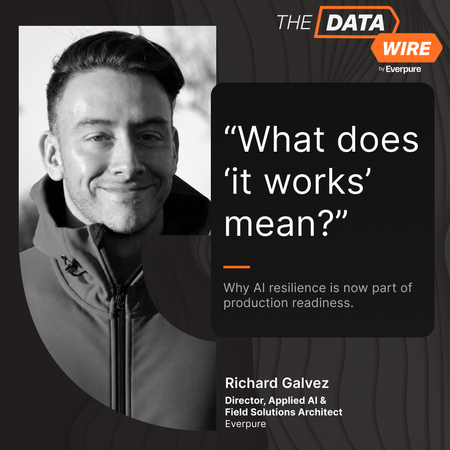
Would love your take on this Data Wire piece with MikeRusso and Ricard Galvez on moving AI from pilot into production in capital markets. One question from Richard really stuck with me: what does “it works” actually mean? A model can pass its evaluation and still not make the work better, faster, or less expensive. Pilots measure whether the model performs. Production has to measure whether the work improved. That second test is harder, and it often does not have a clear owner. So I’m curious: on your team, what does “it works” mean for AI?What’s getting in the way of AI moving into production?
Hi everyone! A lot of companies are experimenting with AI. Fewer are getting those projects into production. This Data Wire article looks at what can slow that down in financial services, including data readiness, governance, orchestration, and resilience. What are you seeing? What’s the biggest hurdle between an AI pilot and production? Would love to hear what others are seeing in the field.155Views2likes0Comments
The Art of Sizing: Breaking the Myths of Oracle Compression
If you work in storage or databases, you have probably heard the pitch: turn on Oracle compression, send fewer bytes, save space, reduce I/O, and lower cost. That sounds great on a slide. In the real world, it is often the opposite. This installment of The Art of Sizing breaks down one of the most persistent myths in enterprise infrastructure: that Oracle host-based compression is automatically a win. We are going to walk through the major compression types, where they help, where they hurt, and why the wrong compression decision can actually create more cost, more network traffic, more I/O, and more work for both storage admins and DBAs. The goal is not to say compression is bad. The goal is to size it correctly, understand where it belongs, and avoid paying premium dollars to make your systems do extra work. Why this myth survives Compression has a good reputation for a reason. Historically, it solved real problems. Storage was expensive, bandwidth was limited, and shrinking data was often the simplest path to efficiency. That logic still holds in some places. But in Oracle environments, especially transactional ones, the story gets more complicated. Oracle is not just writing datafiles. It is writing redo, managing undo, reorganizing blocks, updating symbol tables, and sometimes re-processing data later for deeper compression. That means a “smaller data footprint” does not always equal a smaller infrastructure burden. Sometimes it just shifts the burden somewhere else. First, let’s separate the compression families Not all compression is the same, and not all of it behaves the same way in Oracle. 1. General lossless compression This is the classic world of ZIP, GZIP, LZ77, LZ78, DEFLATE, ZSTD, and similar algorithms. The point is simple: reduce size without losing information. These methods are excellent for files, backups, archives, and many data services. Modern storage platforms use fast versions of these ideas in ways that are largely invisible to the application. 2. Lossy compression Think JPEG, MP3, MPEG, and H.264. These formats intentionally throw away some data in exchange for dramatic size reduction. They are incredibly effective for media, but they are not relevant for Oracle datafiles because databases generally require exact fidelity. 3. Oracle database compression This is where the confusion starts. Oracle has several different compression approaches, each with different behavior, licensing implications, and performance trade-offs: - Basic Table Compression - Advanced Row Compression - Advanced Index Compression - SecureFiles LOB Compression - Hybrid Columnar Compression - RMAN Backup Compression - Automatic Data Optimization and ILM-driven background re-compression Lumping all of those together under “Oracle compression” is one of the fastest ways to make bad architecture decisions. The big myth: compressed writes mean less work Here is the myth in plain English: If Oracle compresses the data before it sends it to storage, the network carries fewer bytes, the array writes less data, and the whole system gets more efficient. What that myth ignores is the full lifecycle of an Oracle write. In active transactional systems, Oracle prioritizes commit latency. That means the redo stream is written first, and it is written uncompressed. Later, as blocks fill and thresholds are crossed, Oracle may compress or re-compress them in memory. That structural change can generate additional redo. If data is later pushed into deeper formats through background optimization or archive-style compression, the system may read, process, and write the same data again. So yes, one part of the path may get smaller. But the total system effort often gets bigger. Figure 1: The life of a compressed I/O inside Oracle (OLTP write path). Notice that data is NOT compressed when it first travels to storage as redo, that write amplification happens at the threshold-hit step, and that this is where the footprint can start to grow. How to actually see it happening This is the part both DBAs and storage admins care about: how do you know Oracle is revisiting blocks, delaying compression, and generating extra work after the commit already succeeded? The threshold delay, in plain English With Advanced Row Compression, Oracle does not usually compress every row the moment it is inserted. Instead, rows are typically written into the block uncompressed first so Oracle can keep transactional latency low. Oracle keeps watching the remaining free space in that 8KB block. Once the block crosses an internal fullness threshold, Oracle goes back, builds or updates the symbol table, batch-compresses the block in memory, and then has to account for that structural change. That delayed work is what I mean by the threshold delay. So the timeline looks more like this: user writes data Oracle writes redo for durability commit returns quickly the block stays in buffer cache the block fills further threshold is crossed Oracle compresses or re-compresses the block in memory additional redo and block maintenance activity can follow That is why the system can look quiet at commit time and then busy again later. How you can tell Oracle is "redoing" things You are usually not looking for one giant smoking gun. You are looking for a pattern where post-commit activity does not line up with the simple story of "we wrote it once and moved on." Common signs include: redo generation that seems higher than expected for the amount of business data changed continued redo and log write activity after the original insert burst is over CPU spikes around block maintenance rather than just around user SQL periodic write bursts that do not line up cleanly with front-end transaction volume maintenance-window bandwidth spikes when colder data is being reworked into deeper compression formats storage-side churn where the array still sees a lot of activity even though the data was supposedly "compressed already" At the database layer, the giveaway is often the mismatch between application change volume and the total work observed in redo, background activity, and later data movement. At the storage layer, the giveaway is seeing traffic patterns that look like read-process-write loops rather than a single smooth write path. Why the database can get larger after a few days This confuses a lot of people because they expect compression to make the footprint immediately smaller and keep it smaller. Figure 2: The background ADO/HCC re-compression path. Days or weeks after the initial write, background jobs read cold data off the array, re-process it on the host, and write it back, so segments can grow from extra redo, undo, rewritten copies, and unreclaimed space. But Oracle compression can create delayed growth behaviors for several reasons: new rows may land uncompressed first and only later be reorganized recompression work can generate extra redo and undo background optimization jobs may read old blocks, reorganize them, and write new versions back out old extents may not be reclaimed immediately even after data is moved or rewritten free space inside segments may become fragmented in ways that do not instantly shrink the physical files if data is updated repeatedly, blocks can split, migrate, or be rewritten in ways that increase segment size before any long-term savings appear So what looks like "compression should have made this smaller" can become "the system created more structures, more history, and more rewritten copies before it settled down." For storage admins, this often shows up as a database that writes out one size on day one and then consumes more logical or physical space over the next several days as Oracle continues block maintenance, redo generation, archive activity, and background reorganization. The practical operator lesson If you want to understand whether compression is helping or hurting, do not just compare the first write size to the final stored size. Instead, look at the full lifecycle: initial redo volume later redo spikes buffer-cache and CPU behavior around block fullness archive log growth background maintenance windows segment growth over time instead of only at load completion storage bandwidth and write churn several days after the original ingest That is where the threshold delay becomes visible. That is where the myth breaks. Why host-based compression can cost more money This is where The Art of Sizing matters most. Compression is often sold as a capacity story, but in Oracle it can quickly become a licensing and CPU story. Advanced Row Compression and SecureFiles LOB Compression are paid features. That means you are not just paying in cycles, you may be paying in Oracle licensing. And if compression overhead pushes CPU consumption higher, you may end up needing to license more cores just to preserve the performance you had before. That is a brutal trade: - You pay for the compression feature. - You spend host CPU running the compression feature. - You may need more licensed cores because of the compression feature. - You still do not eliminate redo overhead. At that point, “saving space” can become one of the most expensive optimizations in the stack. Why it can create more network traffic This is the part that surprises people. On transactional writes, the redo stream still moves as uncompressed change data so Oracle can preserve low-latency commit behavior. That means the initial transactional path does not magically shrink just because the table eventually lands in a compressed state. Then the hidden traffic starts: - secondary redo generated when blocks are compressed or re-compressed - additional log activity to track structural changes - background movement when colder data is reorganized into deeper compression formats - read-process-write cycles for jobs like ADO or HCC-related maintenance For the SAN, that can mean less of a neat “compressed payload” story and more of a churn story. Why it can create more I/O Storage admins know this instinctively: once a system starts revisiting the same data repeatedly, the theoretical savings usually get eaten by operational noise. That is what can happen here. A write is not always a single write anymore. It can become: - the original transactional activity - redo logging for durability - later in-memory compression work - secondary redo for compression state changes - future background read-and-rewrite operations for deeper compression That is not reduced work. That is redistributed work, with extra steps. For busy OLTP systems, that redistribution can show up as more write amplification, more jitter, and more performance variance than people expected when they first heard the word “compression.” Why it creates more operational work Compression decisions do not just affect hardware. They create administrative drag. DBAs have to understand which compression mode is active, what is licensed, what is free, what silently triggered usage, and how it affects redo, CPU, and maintenance windows. Storage admins have to explain why the array still sees redo churn, why bandwidth spikes appear during data reorganization, and why dedupe or downstream efficiency may not look the way a simplified Oracle story suggested. And everyone gets more work when performance troubleshooting starts with a bad assumption. A quick breakdown of the Oracle compression types Basic Table Compression Good for bulk loads and relatively static datasets. It is not a magic answer for active transactional workloads because standard ongoing DML does not benefit the same way. Advanced Row Compression This is the big one in OLTP discussions. It supports active transactional operations, but it is also where deferred compression, block threshold behavior, secondary redo, and paid licensing can combine into a very expensive surprise. Advanced Index Compression Useful in the right indexing scenarios, especially with repetitive keys. This is more targeted and usually not the villain in the story, but it still needs to be understood separately from table compression. SecureFiles LOB Compression Can reduce footprint for large objects like documents, JSON, XML, and similar content, but it pushes work onto host CPU and can throttle ingestion performance when volumes are high. Hybrid Columnar Compression Very powerful for analytics, archival, and cold data patterns. It is not designed like OLTP row compression, and it often belongs in a very different conversation. When used through background movement or deep reorganization, it can generate substantial read-process-rewrite churn. RMAN Backup Compression A separate discussion from live transactional compression. Useful when applied deliberately, but some algorithms can also introduce licensing implications. The sizing lesson This is the heart of the series. Do not size from the brochure claim. Size from the full path of work. When evaluating compression, ask these questions: - What happens on the initial write path? - What happens to redo? - What CPU tax lands on the host? - Does this feature introduce licensing cost? - Will background maintenance create bursts of read-write churn later? - Is the data really a good fit for host-side database compression, or would array-level reduction be cleaner? If you do not answer those questions, you are not sizing compression. You are just hoping it behaves the way marketing described it. Where compression often belongs instead For many environments, especially where modern storage platforms provide inline reduction, the cleaner design is to let the database do database work and let the array do storage work. Figure 3: Myth vs reality, where should compression live? Host-side compression adds CPU, redo, and license cost, while array-level compression keeps host writes normal and delivers predictable I/O with global dedupe. That changes the equation: - less host CPU consumed by compression logic - fewer surprises tied to paid database options - fewer extra redo side effects from re-compression behavior - more predictable storage-side efficiency - a simpler operational model for both DBAs and storage teams That does not mean every Oracle compression feature is wrong. It means compression should be placed where it creates the least total system friction. And in many real-world environments, that is not at the host. Final thought: compression is not free just because it saves space Compression can absolutely be part of a smart architecture. But if you only measure saved capacity and ignore processor cost, network churn, redo behavior, maintenance overhead, and operational complexity, you can easily end up paying more to store less. That is the myth this post is here to break. In The Art of Sizing, the best design is not the one with the smallest number on a capacity chart. It is the one that delivers the best total outcome across cost, performance, simplicity, and operational sanity. And when it comes to Oracle compression, that usually starts with asking a harder question: Is this actually reducing work, or just moving it somewhere more expensive? Coming next In the next installment, we will look at the relationship between compression and encryption in Oracle, and why that combination can further change what the storage team sees and what the database team pays for.144Views0likes0CommentsAccelerate 2026 - Part 2 - The Light Switch Test
Earlier, in Part 1, I wrote that the Everpure Accelerate 2026 opening keynote did not really feel like a storage keynote. My takeaway from day one was simple: Everyone wants your data. The bigger question is who owns the context. Day two answered a different question. If day one was about why the Enterprise Data Cloud matters, day two was about how customers are supposed to get there without turning it into another giant transformation project that sounds great on stage or in a boardroom and then dies somewhere between budget approval, staffing constraints, internal politics, and the next urgent outage. That is why the second keynote mattered. It was not trying to restart the vision. The vision had already been established. It was about turning that vision into something customers could actually use: a methodology, a blueprint, and a way to connect data architecture to risk reduction, efficiency, agility, modernization, and business outcomes. And then John Colgrove, Coz, did what Coz does. He simplified the whole thing. Not by making it smaller. By making it clearer. The phrase that stayed with me from his session was not a technical phrase. It was not Enterprise Data Cloud, Data Primacy, Fusion, data intelligence, or workload mobility, even though all of those ideas were underneath what he was saying. It was the light switch. Coz talked about walking into a room at home and turning on the light. You know exactly what is going to happen. It is simple. It is obvious. It works the way you expect it to work. Then he compared that to walking into a conference room at the office, where five people spend the first few minutes trying to figure out how to turn on the right lights, dim the screen area, wake up the display, connect the laptop, and make the audio work. Everyone has lived that moment. It is also a perfect way to explain what Everpure has been trying to do since the beginning. Make the complicated thing feel like the light switch. That may sound too simple for enterprise infrastructure, but I think it is exactly the point. The best infrastructure does not feel simple because the problem is simple. It feels simple because somebody did the hard engineering work to hide complexity without hiding control. That has always been part of the Everpure story. When Pure Storage first became known in the market, the message was not only flash performance. Performance mattered, of course. But the thing customers really felt was that the experience was different. The arrays were simpler. The upgrades were non-disruptive. The support model was different. Evergreen architecture was different. The idea that you could keep modernizing without the usual forklift pain was different. Over time, that simplicity moved from one array to more of the environment. Fusion extended the idea from a single system to a fleet. Policy, placement, automation, workload mobility, service levels, compliance, and lifecycle management started to move from device-by-device thinking toward something broader. Now, with the Enterprise Data Cloud, Everpure is trying to move that simplicity again. From array to fleet. From fleet to data. From data storage to data management. That was the thread both Nirav Sheth and Coz pulled through the keynote, and I think it connected day two back to day one in a very useful way. They made it clear that the move from Pure Storage to Everpure is not an abandonment of what got the company here. It is a continuation of the same journey. That matters because customers are rightfully skeptical when technology companies rebrand or expand their message. They wonder whether the company is moving away from the thing they trusted. They wonder whether the new story is strategy or just vocabulary. Coz addressed that directly. We are not abandoning storage infrastructure. We are going to keep building the best storage infrastructure we can. But we are also going higher, because to build better infrastructure, you have to understand more about the data above it. That is a founder’s version of the message. Less theater. More first principles. If you store data, you want to know what it is. You want to know how it will be accessed. You want to know how often. You want to know what it relates to. You want to know whether there are copies. You want to know whether those copies create risk. You want to know whether the rules are being followed. The problem, as Coz pointed out, is that nobody really knows the future. The infrastructure has to be built for agility. That word gets overused, but in this context it matters. Agility is the ability to change without breaking everything. It is the ability to move workloads non-disruptively. It is the ability to rebalance a fleet. It is the ability to modernize hardware without turning it into a migration event. It is the ability to adjust policies as risk changes. It is the ability to bring intelligence to data that already exists instead of forcing the business to start over. That is where the Enterprise Data Cloud story becomes more practical. And I personally think the Enterprise Data Cloud Success Blueprint was the clearest example of that. I liked this part because it moved the conversation away from “look at all these capabilities” and toward “here is why it matters to you” and “what outcomes are you trying to drive?” That is where a lot of technology conversations go wrong. We get excited about the architecture and forget that customers are not buying architecture for the sake of architecture. They are trying to solve business problems with limited people, limited time, limited budget, and increasing pressure from every direction. They are dealing with supply chain constraints. They are being asked to do more with the same team. They are trying to create VMware optionality without making a reckless move. They are modernizing applications while still running legacy workloads that cannot just disappear. They are dealing with cyber risk, ransomware, and minimum viable business recovery. They are being asked to support AI before the data foundation is ready. The blueprint framework organized those pressures into three simple categories: risk reduction, efficiency, and agility. That may seem obvious, but obvious is underrated. Risk reduction is not just a security feature. It is knowing whether your data is protected, whether your snapshot policies are aligned, whether you can recover the minimum viable business, whether sensitive data is duplicated everywhere, and whether compliance follows the data instead of living in someone’s spreadsheet. Efficiency is not just a density number. It is energy efficiency, automation, operational scale, fewer manual tasks, fewer migrations, and fewer people spending nights and weekends babysitting infrastructure that should be managing itself. Agility is not just modernization language. It is VMware optionality, container readiness, AI readiness, cloud flexibility, application mobility, and the freedom to make the next decision without being trapped by the last one. I think that is a much better way to have the conversation with customers. Not “Do you want this product?” But “Which business outcome are you trying to improve, and what is standing in the way?” The Red Hat and CSX discussion made that practical. When Eric Grabill from CSX talked about Positive Train Control, sensors along the tracks, safety requirements, and systems where a loss of data can affect train operations, the conversation moved from platform strategy into the real world. That is where infrastructure earns its keep. CSX has already moved a large portion of its applications to Kubernetes on OpenShift, but still has legacy VMs remaining. That is the real enterprise pattern. It is not containers or VMs. It is containers and VMs. It is cloud and on-premises. It is modern and legacy. It is AI coming next while everything else still has to run today. The Red Hat and Portworx conversation made the point that modernization cannot mean creating another disconnected stack. Customers need one operating model across VMs, containers, and eventually AI workloads. They need a practical transition path, not a big bang migration. They need data services that protect the applications, not just compute platforms that can host them. The St. Elizabeth Healthcare conversation made the same point in a more personal way. Charles Shepherd talked about joining St. Elizabeth in 1997, starting at the help desk, moving through Novell, GroupWise, backups, storage, and eventually becoming part of the team responsible for systems that support a healthcare environment that never really stops. What stayed with me was not only the technical story. It was the laptop on vacation. Anyone who has worked in infrastructure understands that detail. The laptop that comes with you just in case. The phone you keep checking because maybe something happened. The family event where part of your brain is still in the data center. The trip where you are physically present but operationally on standby. That is not a feature comparison. That is a life comparison. Charles said he recently was able to go to his niece’s graduation and not get called. That sounds small only if you have never been the person who always gets called. He also talked about more than one hundred hardware upgrades and more than one hundred fifty Purity upgrades without downtime. He talked about moving from older systems to modern ones without the traditional forklift migration pain. He talked about change boards becoming comfortable with upgrades during the day because the process had earned trust. That is the kind of customer proof that matters. It shows what the solution that was delivered gives back. It gives back time, trust and confidence. That connects directly to the light switch idea. Simplicity is not cosmetic. It is not just a better UI. It is not just fewer clicks. Simplicity changes what people can spend their time on. It changes what teams believe they can safely do. And it changes whether the infrastructure team is trapped maintaining the past or free to prepare for what comes next. Coz also said something important about time. This Enterprise Data Cloud journey is not a one-year story. It is not one product cycle. It is not done because it showed up in an Accelerate keynote. Coz described it as a journey that will take five to ten years, and even then, it will not really be done because the solution will keep improving. I appreciate that kind of honesty. So when a founder says this is a long journey, I believe that more than I believe a slide that says “seamless transformation” in large font. But I also think now is the right time for the journey to become possible. And Coz reminded us that the best version of this is not complexity with better branding. The best version is the light switch. Coz, in the most Coz way possible, reminded everyone that the goal is not to make enterprise infrastructure sound impressive. The goal is to make the hard things feel obvious. Like turning on the lights. I appreciate you reading. Dmitry Gorbatov © 2025 Dmitry Gorbatov | #dmitrywashere108Views0likes0CommentsWebinar: What It Takes to Build AI-Ready Telco Clouds
Shameless plug, Fierce Network hosted a webinar with Nokia, Everpure, and Red Hat. In this webinar, Nokia, Red Hat, and Everpure will share perspectives on the strategic considerations shaping next-generation telco cloud design—from standardization and lifecycle management to data readiness, operational efficiency, and support for distributed environments from core to edge. The session will explore how service providers can think about building a modern telco cloud foundation that is better prepared for automation, analytics, and long-term innovation. Check out the Webinar here200Views1like0CommentsKeeping Your Fleet Up-to-Date Just Got a Lot Easier
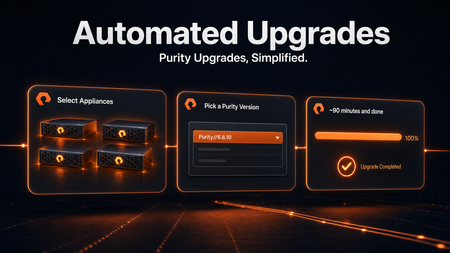
Did you know: 95% of Purity upgrades now finish in under 90 minutes. You can run them in parallel and your whole fleet finishes in the same time it takes to do one. Every Purity release delivers more: better performance, new capabilities, the latest security updates. Staying current is how you keep pulling value out of hardware you already own. At Everpure, upgrades shouldn't be something you plan your week around, or something that delays the benefits every Purity release brings. Self-Service Upgrades in Pure1 (SSU) let you upgrade Purity on your own schedule, directly from Pure1, without opening a support ticket. It has quietly become the most popular way customers keep their fleets current. What's new: Automated SSU SSU has always given you full control over the upgrade flow, with mandatory pauses after each major step (health check, download, installation) and deciding when to continue. For teams who want to validate at every checkpoint, that is exactly how it should work and that manual flow isn't going anywhere. For everyone else, it meant mandatory delays and too much hands-on involvement. Arrays sitting idle between phases, waiting for someone to click through.More time spent on an upgrade than necessary, and enough that some teams never tried SSU at all, and kept pushing upgrades for later. Automated SSU is the option for those who want to go fast without giving anything up. Pick any number of appliances, select the target Purity version, authenticate, and go. The workflow runs to completion on its own, non-disruptive by design, so your workloads keep running throughout. If anything goes wrong, the upgrade pauses on that appliance and a proactive case opens with Everpure Support. Over 100 automatic health checks run before and during the upgrade, and the workflow won't move past a critical failure. First response from Support is typically 30 minutes for install issues, 60 minutes for others. Built for fleets Need to cover your whole fleet? Select your appliances in bulk, hit go, and they upgrade in parallel, finishing in the same time it takes to do one. The Software Lifecycle dashboard shows you exactly what's running, what's done, and what (if anything) needs your attention. If your target version is several releases ahead, SSU computes the upgrade path and runs the intermediate hops on its own. Get started in 15 minutes Not on SSU yet? The one-time setup takes about 15 minutes: enable cloud connection on each appliance from the CLI, then bulk-install the Purity Upgrade Agent from Pure1. After that, it is ready when you need it. Give Automated SSU a try. It really is easier than you think. Full SSU prerequisites and setup guide246Views1like0Comments